The AI Revolution: Shifting from Passive to Self-Directed Learning
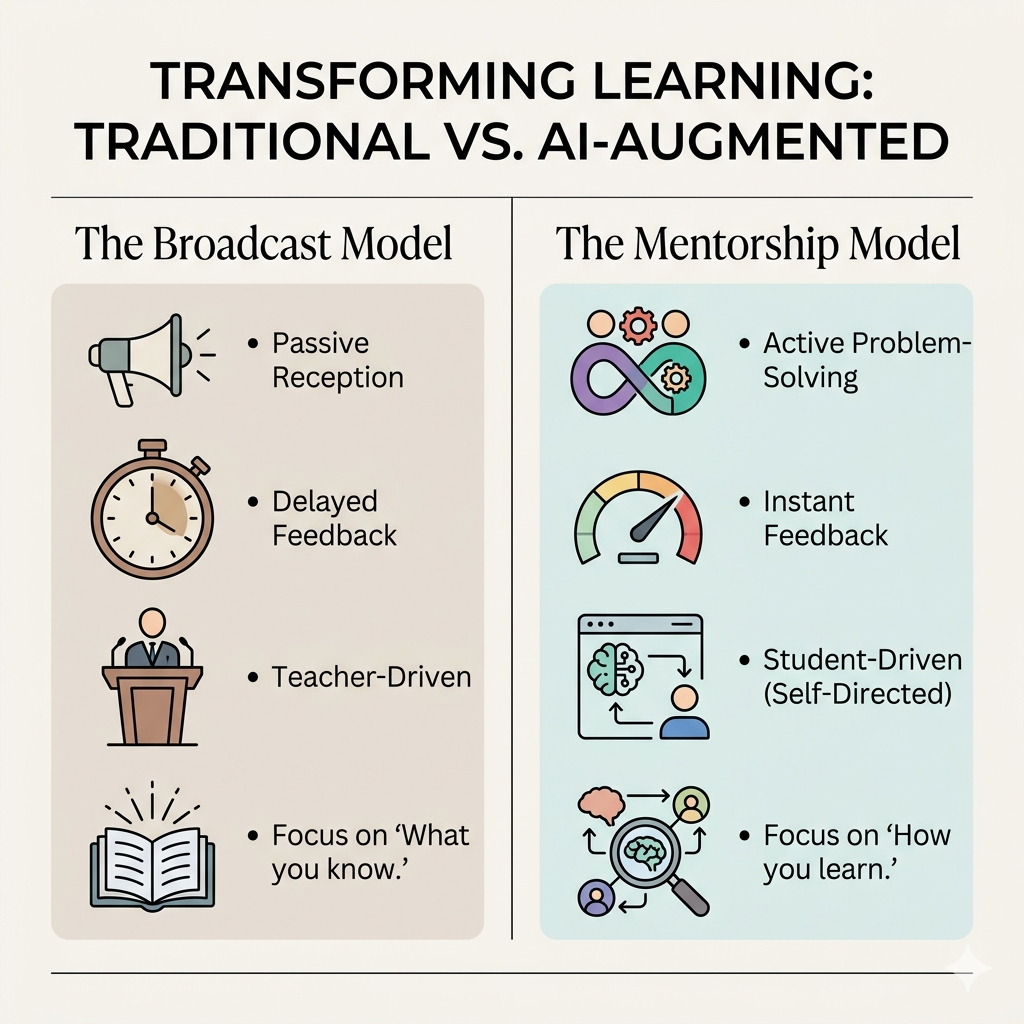
In the traditional educational model, students are often passive recipients. They wait for the teacher to deliver content, wait for the exam to test knowledge, and wait days for feedback to understand their mistakes.
In the traditional educational model, students are often passive recipients. They wait for the teacher to deliver content, wait for the exam to test knowledge, and wait days for feedback to understand their mistakes. This delay stifles Self-Directed Learning (SDL) because the learner loses momentum before they can take ownership of their mistakes.
What is Self-Directed Learning and Why Does it Matter?
Self-directed learning is not just studying alone. According to the Personal Responsibility Orientation Model (PRO), it is a process where individuals take primary responsibility for planning, implementing, and evaluating their own learning efforts. In a world defined by rapid technological change, the ability to learn independently is the ultimate survival skill. SDL fosters Agency and Resilience, transforming a student from a consumer of facts into a proactive problem-solver. Without it, learners remain dependent on external instruction; with it, they gain the capacity for lifelong mastery and the confidence to navigate any new challenge.
How AI Accelerates the Shift
AI shifts this paradigm by providing what schools previously couldn't: Instant, Granular Feedback. Based on the PRO Model self-direction isn't just a skill; it’s a mindset of taking responsibility for one's learning process. AI tools allow students to move at their own pace, engaging in Socratic dialogues that "nudge" rather than "tell”. When a student uses an AI Subject Mentor, they are no longer waiting for permission to progress. They engage in a real-time, iterative loop: they attempt, they receive immediate Socratic guidance, and they adjust.
This immediate feedback builds self-efficacy, the belief that one's effort leads to results. AI doesn't just provide answers; it provides the tools for students to audit their own thinking. This shifts the classroom dynamic from a broadcast model to a mentorship model, where the student drives the inquiry, and the teacher ensures deep, conceptual mastery.
In the AI era, the value of a student is no longer what they know, but how effectively they can learn. By removing the feedback bottleneck, AI empowers students to transition from passive consumers to proactive architects of their own mastery.
Learn More
We deliver focused training on every topic we write about.
Contact Us