What Are Character Strengths, and Why Every School Should Be Talking About Them
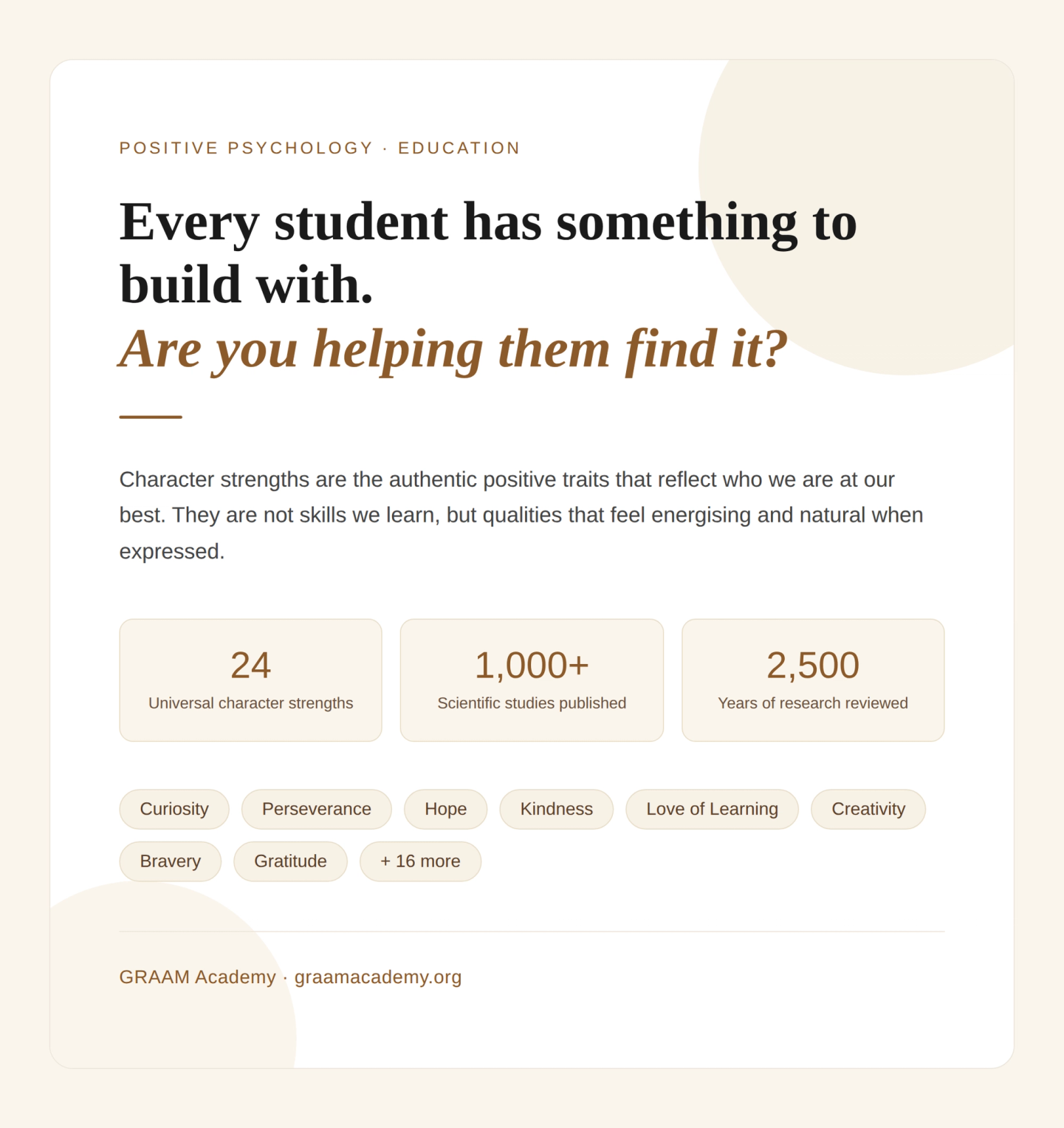
Character strengths are the authentic positive traits that reflect who we are at our best. With over 1,000 scientific studies and 24 universally valued strengths, this framework is reshaping how schools support students. Here is what every educator should know.
In a classroom somewhere this week, a student who struggles with maths will be recognised by her teacher for the curiosity and perseverance she brings to every problem, even the ones she gets wrong. In another, every teacher will know the language of strengths well enough to name what makes each student come alive. These schools are not theoretical. They are part of a growing global movement, and the science behind it is compelling.
What Are Character Strengths?
Character strengths are the positive personality traits that reflect who we are at our best. They are not skills we learn or performances we put on. They are the authentic qualities that feel effortless and right when we live them out, the parts of us that energise us when we express them.
Over a three-year global research project examining character across more than 2,500 years of philosophy, religion, and culture, psychologists Christopher Peterson and Martin Seligman identified 24 character strengths that are universally valued across civilisations. These 24 strengths cluster into six broad virtues:
Wisdom: Creativity, Curiosity, Judgement, Love of Learning, Perspective
Courage: Bravery, Perseverance, Honesty, Zest
Humanity: Love, Kindness, Social Intelligence
Justice: Teamwork, Fairness, Leadership
Temperance: Forgiveness, Humility, Prudence, Self-Regulation
Transcendence: Appreciation of Beauty, Gratitude, Hope, Humour, Spirituality
Today, with over 1,000 scientific and scholarly articles published on character strengths (VIA Institute of Character, 2026), this framework has become one of the most rigorously researched approaches to human flourishing in modern psychology.
Why Character Strengths Matter for Young People
The case for character strengths in schools is not just philosophical. It is supported by a growing body of research.
For individual students, the evidence consistently shows that when young people are aware of and use their character strengths, they experience higher life satisfaction and positive emotions (Gander et al., 2013; Proctor et al., 2011). They demonstrate better academic achievement across middle school and college (Karris Bachik et al., 2021; Park & Peterson, 2009). They also report stronger psychological well-being and resilience (Zhang & Chen, 2018).
For classrooms and school communities, the benefits extend beyond the individual. A landmark six-session programme called Awesome Us (Quinlan et al., 2015), designed for students aged 9 to 12, found that participants who engaged with strengths-based activities showed higher positive affect and engagement, greater autonomy and sense of control, stronger class cohesion and relatedness, and lower classroom friction.
When students know their strengths, and see each other's, something shifts. The classroom stops being a place of comparison and becomes a place of contribution.
From a Single Exercise to a Living Culture
Early character strengths programmes often began simply. Teachers would ask students to identify their top strengths and use them in a new way for a week. The exercise was effective, but limited.
Over the past decade, research and practice have evolved considerably. Today, schools around the world are embedding character strengths into comprehensive, multi-intervention approaches that reach across subjects, year groups, and school culture. These programmes increasingly mirror what psychologist Ryan Niemiec (2014) calls the Aware-Explore-Apply model:
- Aware. Help students discover and name their character strengths.
- Explore. Invite curiosity about how those strengths show up in daily life.
- Apply. Build concrete habits and plans for strengths use in and outside school.
Character strengths education has also expanded well beyond the average student. Research now supports its application in diverse demographics and contexts, including multicultural settings (Tukiyo et al., 2023), students involved in sports (Walker et al., 2023), anti-bullying initiatives (Gülbahar & Sari, 2022), and young people who have experienced domestic violence (Hellman & Gwinn, 2017).
The Concept of Signature Strengths
Among your 24 character strengths, there is a subset that feels particularly you. These are called your signature strengths. They feel natural and authentic to express, give you energy rather than drain you, are present across many areas of your life, and feel like this is who I am rather than this is what I am trying to do.
Research shows that applying four or more signature strengths in daily life, especially in work or learning, is associated with experiencing your activities as a calling rather than a task (Harzer & Ruch, 2012). The key insight is that it is not about having one defining strength, but about cultivating a rich, balanced constellation of your authentic strengths.
What This Means for Schools and Educators
If you are an educator, school leader, or anyone who works with young people, character strengths offer a quiet but significant shift in how we approach development:
Every student already has something to build with. The work of education is not only to fix deficits, but to illuminate what is already there.
Character strengths give teachers and students a shared language. That language moves conversations from "what went wrong?" to "which strengths can we bring to this?" Over time, the change in tone changes the culture.
At GRAAM Academy, this is central to everything we do. Whether we are training teachers, running youth workshops, or partnering with organisations, the work always begins with one question:
What is strong in you?
Getting Started: Three Simple Practices
You do not need a full programme to begin. Here are three evidence-based starting points.
1. Take the VIA Survey. The free VIA Character Strengths Survey takes about 15 minutes and ranks all 24 of your strengths. It is available for adults and youth aged 10 and above, and is a meaningful first step for any educator or student.
2. Introduce the Language. Start naming strengths when you see them, in yourself, in your students, in your colleagues. "I noticed your curiosity in the question you asked today." Specific, honest recognition changes the climate of a space.
3. Try a Strengths Reflection. Ask students: When do you feel most like yourself? What were you doing? Then explore which character strengths might have been at play. Reflection builds awareness, and awareness is where most growth begins.
The Research Is Clear. The Opportunity Is Here.
We are living through a moment when youth mental health, school belonging, and student engagement are all under pressure. Character strengths do not solve everything, but they offer something essential: a strengths-based lens that sees young people as capable, whole, and worth investing in.
The science is solid. The methods are practical. The invitation is open.
GRAAM Academy offers training programmes in Positive Psychology and AI-powered tools for schools and organisations. Explore our workshops and resources at graamacademy.org.
References
- Gander, F., et al. (2013). Strength-based positive interventions. Journal of Happiness Studies, 14, 1241–1259.
- Harzer, C., & Ruch, W. (2012). When the job is a calling. The Journal of Positive Psychology, 7(5), 362–371.
- Karris Bachik, M. A., et al. (2021). VIA character strengths among U.S. college students. The Journal of Positive Psychology, 16(4), 512–525.
- Niemiec, R. M. (2014). Mindfulness and character strengths. Hogrefe.
- Niemiec, R. M. (2018). Character strengths interventions. Hogrefe.
- Park, N., & Peterson, C. (2009). Character strengths: Research and practice. Journal of College and Character, 10(4).
- Peterson, C., & Seligman, M. E. P. (2004). Character strengths and virtues. Oxford University Press.
- Proctor, C., et al. (2011). Strengths gym. The Journal of Positive Psychology, 6, 377–388.
- Quinlan, D. M., et al. (2015). How 'other people matter' in a classroom-based strengths intervention. The Journal of Positive Psychology, 10(1), 77–89.
- VIA Institute on Character. (2026). What the research says about character strengths. https://www.viacharacter.org/research/findings
- Walker, D.I., et al. (2023). The role of character strengths on adolescents' participation in sports. Journal of Psychology and Psychotherapy Research, 10.
- Zhang, Y., & Chen, M. (2018). Character strengths and subjective well-being. Frontiers in Psychology, 9, 1040.
Learn More
We deliver focused training on every topic we write about.
Contact Us