The Strengths That Build Purpose: What 9,000 People Taught Us About Character and Calling
New research on the character strengths most strongly tied to purpose: spirituality, hope, and love of learning. What it means for schools and workplaces.
A calling rarely arrives fully formed. It gets assembled, piece by piece, from the things we are good at and the meaning we keep choosing to see. A new study of more than nine thousand people gives us the clearest picture yet of which pieces do the most work.
Christina Schwartz, Kendall Bronk, Ryan Niemiec and their colleagues set out to answer a question that sounds obvious but had barely been tested: which character strengths are most closely tied to a life of purpose? They surveyed 9,316 adults using the VIA Inventory of Strengths and the Claremont Purpose Scale, then asked an open-ended question about how those strengths actually helped (Schwartz et al., 2025).
What purpose means here
The study uses a precise definition. A purposeful commitment is an enduring intention to contribute, in personally meaningful ways, to the world beyond yourself (Damon et al., 2003). It holds three parts together:
- goal-directedness: a long-term goal you are moving toward
- personal meaning: the active investment of your time and energy because it matters to you
- beyond-the-self orientation: an intent to make a difference and contribute to a broader world beyond the self
That third part carries most of the weight. It is what separates a genuine purpose from a private sense that your life simply has direction, and it is the dimension that connects purpose most directly to character.
Three strengths keep rising to the top
When the researchers looked at purpose as a whole, three character strengths stood out above the rest, even after accounting for the other twenty-one and for age, gender, ethnicity, and income. Spirituality showed the strongest relationship, followed by hope and love of learning.
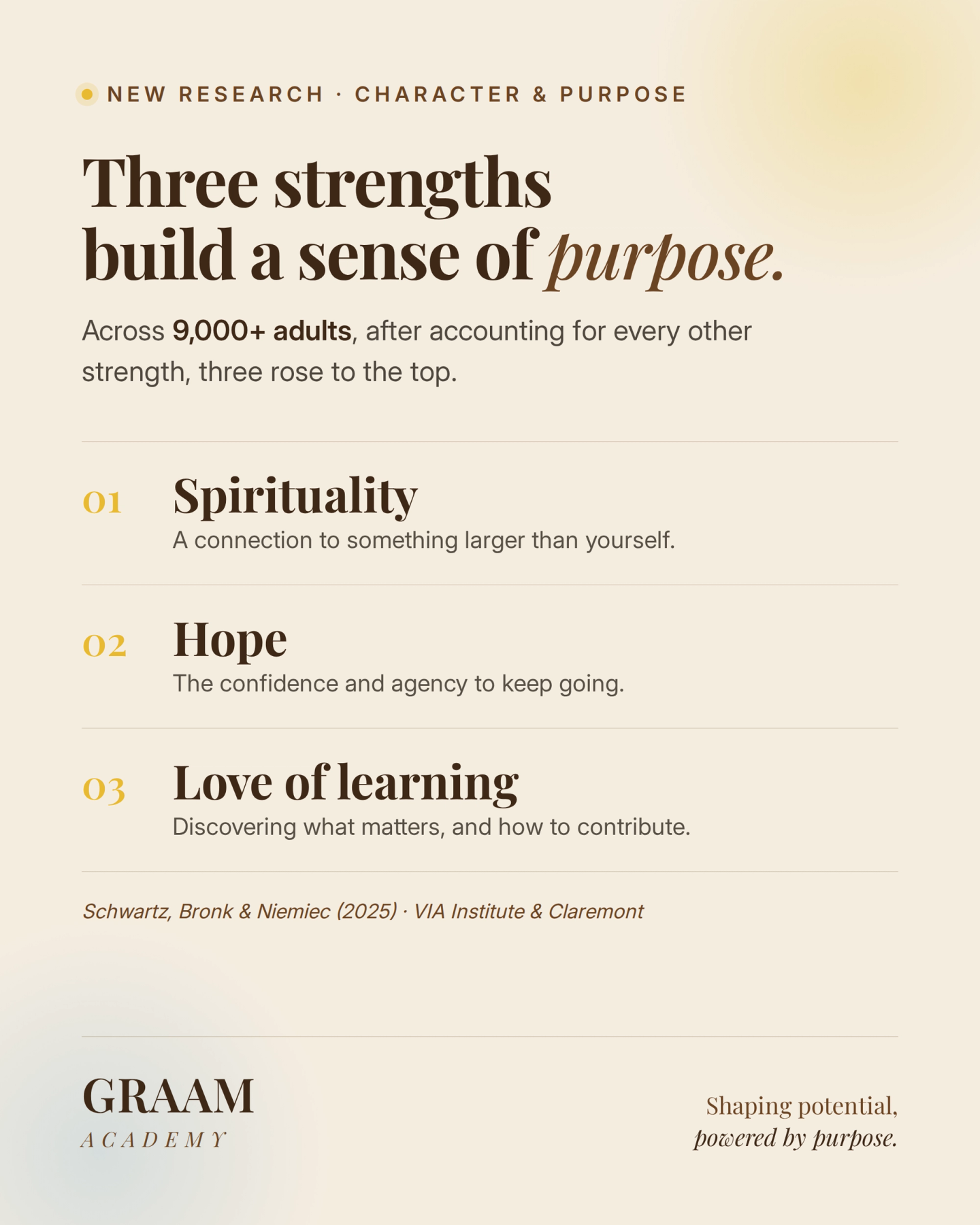
These three are not a random cluster. Spirituality and hope both belong to the virtue of transcendence, the human capacity to connect with something larger than the self. Love of learning belongs to the virtue of wisdom, the work of figuring out what you value and how to act on it. Purpose, this suggests, grows where the reach toward something bigger meets the patient work of understanding.
Different parts of purpose call on different strengths
The more useful finding sits one level down. Each dimension of purpose drew on a different set of strengths, which means there is no single recipe. There are three, depending on which part of purpose needs support.
- Goal-directedness - perseverance · hope
Holding a long-term aim is mostly a matter of staying power. Perseverance led here, with hope close behind, joined by self-regulation and love of learning. This is the strength set for the long middle of any purpose, after the early excitement fades and before the payoff arrives. - Personal meaning - spirituality · hope
The felt sense that an aim matters drew most on spirituality and hope, with zest and gratitude adding energy and a reason to stay attached to the people and activities involved. - Beyond-the-self - love of learning · kindness · spirituality
The reach outward, toward contribution, was carried by love of learning, kindness, and spirituality. Love of learning matters here in a way it does not elsewhere: knowing more is what lets you actually be useful to other people and causes.
How the strengths do their work
The numbers say which strengths matter. The open-ended responses say how. People described spirituality as a reminder that they were connected to something greater than themselves, and that connection moved them toward service. They described hope as the thing that gave them the confidence and the sense of agency to keep going, especially when the path got hard. And they described love of learning as the engine that helped them discover what mattered to them, and then build the knowledge to do something about it (Schwartz et al., 2025).
Where this meets our work
At GRAAM Academy, this evidence anchors a pillar we have built around purpose. The pillar centres on five purpose-correlated strengths: hope, spirituality, curiosity, love of learning, and perseverance. Each one earns its place by loading on a different part of purpose. Perseverance and hope hold the goal. Spirituality and hope deepen the meaning. Love of learning and curiosity send people exploring and equip them to contribute. Hope runs through all three.
The practical lesson from the wider purpose literature is about sequence. Naming a strength is only the start. What changes a young person, or an employee, is the space to apply it: a leadership role, a service project, a real problem that needs them. Application is what builds self-efficacy and agency, and those are what open the door to purpose. A whole-school or whole-team foundation of strengths awareness comes first, then a deeper, deliberate focus on the strengths most tied to purpose, then somewhere to put them to use.
For educators and leaders
Do the people you guide know their strengths by name, or only their grades and targets?
Where could you create real space to apply a strength: a role, a project, a responsibility that matters to someone beyond them?
Are you nurturing hope and a sense of contribution, or only setting goals?
Read alongside its companion piece on work as a calling, the message is steady. Purpose is not a personality you are born with. It is grown, from strengths that can be named, practised, and put to use in the service of something larger than ourselves.
The ramen master in the first part of this story had hope, a love of his craft, and the perseverance to repeat it until it became excellent. The research now puts names to what he was living. For the schools and organisations we work with, that is the quiet promise in this study: purpose can be cultivated, and we know more than ever about where to begin.
References
- Schwartz, C. M., Kearns, L. P., Sampo, B. L., D'Amico, C. L. J., Swanson, Z. T., Bronk, K. C., & Niemiec, R. M. (2025). Understanding the relationship between character strengths and purposeful commitments. The Journal of Positive Psychology. https://doi.org/10.1080/17439760.2025.2568835
- Damon, W., Menon, J., & Bronk, K. C. (2003). The development of purpose during adolescence. Applied Developmental Science, 7(3), 119–128.
- Bronk, K. C. (2024). Purpose through the lens of character virtue development. In The Routledge International Handbook of Multidisciplinary Perspectives on Character Development.
- Peterson, C., & Seligman, M. E. P. (2004). Character Strengths and Virtues: A Handbook and Classification. Oxford University Press.
- Snyder, C. R., et al. (1991). The will and the ways: Development and validation of an individual-differences measure of hope. Journal of Personality and Social Psychology, 60(4), 570–585.
Learn More
We deliver focused training on every topic we write about.
Contact Us