Your Brain Is Built, Not Born: What Neuroscience Teaches Us About Learning and Environment
This article draws on Neuroscientist Lisa Feldman Barrett's work, Seven and a Half Lessons About the Brain, to explain why real learning takes repetition and why the environments we create for people, in classrooms and at work, quietly shape how their brains grow.
We tend to talk about brainpower as if it were a fixed endowment. Some people are wired for maths, some are natural leaders, some just are not built for a subject. It is a comfortable story, because it lets everyone off the hook. If ability is issued at birth, there is not much point trying to change it.
Neuroscientist Lisa Feldman Barrett spends much of Seven and a Half Lessons About the Brain dismantling that story. A brain, she argues, is not a thing you receive fully formed.
It is something that gets built, tuned by what you do over and over, and shaped by the world it grows up in.
That single shift, from born to built, changes how we should think about learning, teaching, and the environments we put people in.
It was never about size
Start with the oldest version of the myth: that humans are clever because we have big brains, or a big cerebral cortex, the outer layer we associate with thinking.
Barrett is blunt about this. The human cerebral cortex is not proportionally larger than you would expect for a primate of our size. Compared with many other animals, including monkeys and elephants, our brains are not the outlier we imagine. And crucially, the size of a cortex tells you almost nothing about how rational or capable a species is. Bigger is not smarter.
What actually happened over evolution is subtler. Certain genes mutated so that particular stages of brain development ran for longer or shorter times, producing a brain with proportionally larger or smaller parts. In other words, the human brain is not special because of raw size. It is special because of how it is organised and wired. And wiring, unlike the size of your skull, is not fixed. That is where the real story of learning begins.
Wiring deepens with use
Your brain is a network: billions of neurons connected so they can function as a single unit. Neurons pass signals to one another across tiny gaps, and the strength of those connections is not set in stone. This is neuroplasticity, and it is the most hopeful fact in neuroscience.
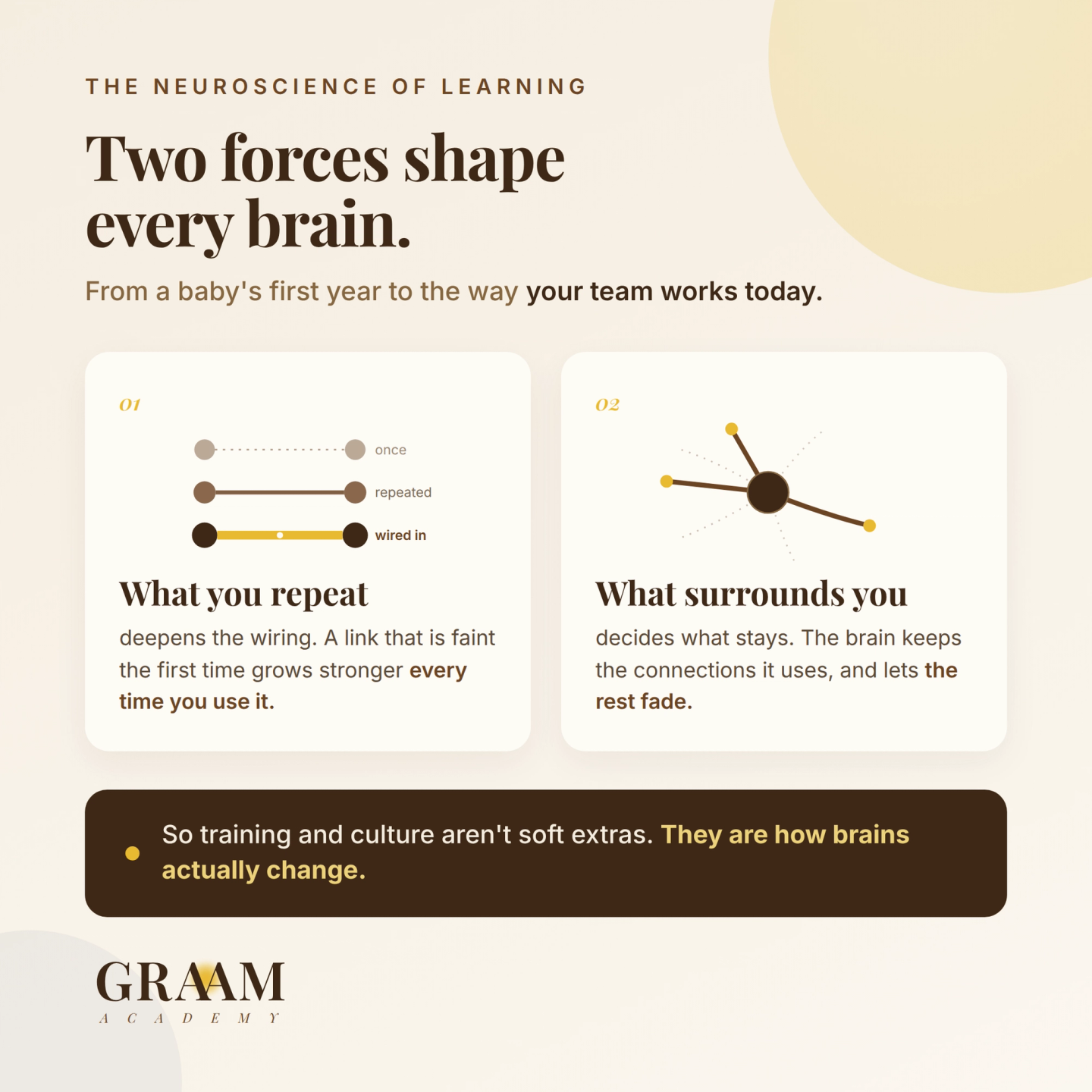
When you learn something new, your neurons build new paths of communication. Repeat that learning, and the wiring deepens. The path that was faint the first time becomes a well-worn road. This is not a metaphor. It is the physical basis of every skill you have ever acquired, from reading to reassuring a nervous colleague.
Two features make the brain remarkably good at this. First, no neuron has a single fixed job. Any given neuron can contribute to more than one function, and some of the most useful ones, in regions like the prefrontal cortex, seem designed to have many jobs at once. Second, the same outcome can be produced by different groups of neurons, a property Barrett calls degeneracy. Your brain has more than one way to reach for a cup, or to feel afraid, or to solve a problem.
Together these give the brain what she calls complexity: the ability to configure itself into an enormous number of distinct patterns by combining bits and pieces of patterns it has made before. This is what lets a brain run its body efficiently in a world that keeps changing, recalling what worked in the past and generating new attempts when it does not. It is also, she notes, the ingredient behind our most human capacities: thinking abstractly, using rich language, imagining a future unlike the present, and being creative.
For anyone in the business of helping people grow, the lesson is practical. Learning is not the transfer of information into a fixed container. It is the deepening of wiring through repetition. A single inspiring workshop rarely changes behaviour, because one exposure is not enough to build durable wiring. What changes people is practice returned to over time, until the new way of doing things becomes the path of least resistance.
A brain wires itself to its world
If repetition explains how the brain deepens, environment explains what it deepens toward. And the clearest window into this is how a brain gets built in the first place.
A newborn arrives with more neurons than an adult brain needs, and with connections far bushier than they will stay. Over the first years of life, the brain becomes more capable through two opposite processes. Frequently used and important connections are strengthened, a process called tuning. Connections that go unused weaken and disappear, a process called pruning. Far from being a loss, pruning is essential: clearing away the connections a child does not need makes room for the ones they do. The brain is quite literally sculpting itself to fit the particular world it finds.
That world is largely made of other people. A caregiver who keeps a baby fed, warm and soothed frees the baby's brain to wire itself for healthy regulation rather than constant alarm. A newborn cannot yet direct its attention, but by following where a trusted adult looks and points, it slowly learns which parts of the environment matter and which can be ignored. Step by step, the people around a child curate the world that child's brain grows into, and that child will one day do the same for the next generation. Barrett has a memorable way of putting it: we have the kind of nature that requires nurture.
The flip side is sobering. Children who develop in socially and materially impoverished environments tend to grow smaller brains, with key regions less developed and fewer connections, along with knock-on effects for their health and mood. A child's environment has a direct, measurable effect on how the brain develops.
What this means for the rooms you shape
Most of us are long past the years of dramatic pruning. But the two forces never switch off. Adult brains still deepen the wiring we use most, and still take their cues from the environments we live and work in. Which means the argument is not only about individuals improving themselves. It is about the environments we build for one another.
If you lead a team, you are part of the environment shaping how those brains work, day after day. A workplace where people feel steady and supported frees attention for learning and good judgement, much as a soothed baby's brain is freed to develop. A classroom that consistently directs attention to what matters is teaching brains what to keep. Culture, in this light, is not a soft add-on. It shapes how the people inside it think and work over time.
So the science leaves us with two levers, and both are within reach. The first is repetition: what we practise, we become, because practice is what deepens wiring. The second is environment: what surrounds us shapes what our brains grow toward. Neither is a quick fix. Both compound.
Bringing it to your people
This is why at GRAAM Academy we treat development as practice built into an environment, not as a one-off event. Real change comes from helping people repeat better habits until the wiring holds, and from shaping the conditions, the culture, the attention, the sense of safety, in which those habits can take root.
A brain is not a fixed hand you were dealt at birth. It is built over time, by what you repeat and by the world you do it in. That asks something of us, but it also means far more is within our reach than the born-this-way story ever allowed.
Reference: Barrett, L. F. (2020). Seven and a Half Lessons About the Brain. Houghton Mifflin Harcourt.
Learn More
We deliver focused training on every topic we write about.
Contact Us