How Emotional Intelligence Is Actually Built
Drawing on Lisa Feldman Barrett's work on how the brain constructs emotion, this article explains why the precision of your emotion vocabulary changes how you cope under pressure, and what that means for how organisations and schools should design development.
Emotional intelligence is trainable, but most leadership programmes aim at the wrong point in the process.
Most leadership development is aimed at behaviour. Give clearer feedback. Listen more. Stay calm in difficult conversations. The intent is right and the results are usually disappointing, because behaviour is the last thing to happen in a sequence, and by the time it arrives most of the decisions have already been made somewhere you were not looking.
The more useful news is that the earlier links in that chain are visible, and there is evidence that working on them changes something you can measure.
First, does training work at all
This is worth settling before anything else, because emotional intelligence has attracted enough hype to make some scepticism reasonable.
The broadest look at the question so far pooled results from more than 250 separate studies covering 78,159 working adults. People with higher emotional intelligence tended to
- perform better in their roles
- help colleagues more readily
- report more satisfaction with their work
- report less stressful in their job
Findings like these show that emotional intelligence travels with good outcomes. They do not show that you can teach it, which is the question an organisation actually has to answer before committing a budget.
A 2024 review took that question on directly, gathering seventeen studies that trained emotional intelligence in healthcare staff and measured them afterwards. Six were randomised trials, the design that comes closest to demonstrating cause rather than coincidence, and across those the trained groups improved substantially more than the untrained ones. The gains were not confined to the skill being taught: participants also managed stress better, recovered more readily from setbacks, and communicated more clearly.
The fair conclusion is that emotional intelligence does respond to training, that nobody yet knows precisely how much, and that how a programme is designed almost certainly matters more than the fact that one took place.
The sequence, and where it can be changed
Barrett's account of the brain overturns a common assumption. We tend to picture the brain as a stimulus and response organ: something happens, we react. The evidence points elsewhere. The brain runs continuously ahead of events, using past experience to predict what is about to happen and preparing the body accordingly, so sensory input arrives as a correction to a prediction already in flight.
In her 2017 paper, Barrett states the mechanism plainly: completed predictions are categorisations. The brain makes sense of a situation by applying a concept to it, and that act of application produces both the meaning of the situation and the emotion that goes with it. On this account, an instance of emotion is constructed when the brain uses emotion concepts to categorise what is arriving from the body and from the world.
Laid out as a sequence, it looks like this:
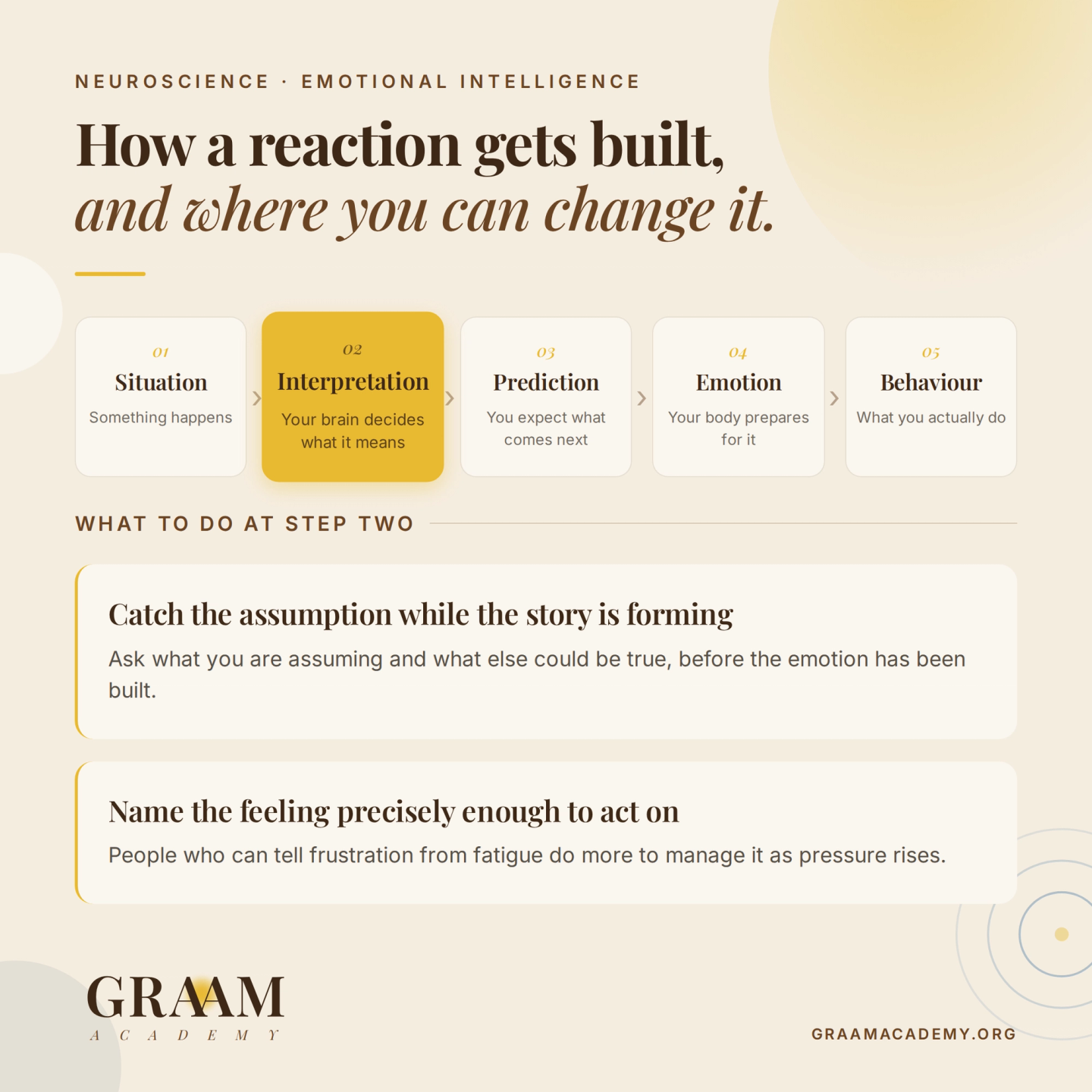
- A situation arrives
- Your brain interprets it using concepts built from everything you have experienced before
- That interpretation generates a prediction about what happens next
- The prediction shapes the emotion your brain constructs. The emotion shapes what you do.
- Behaviour is the fifth step, and it is the step almost all conventional training targets.
The workable point is earlier, at interpretation, and it is workable because interpretation is where correction is still possible. Barrett describes prediction error, the gap between what the brain expected and what arrived, as the learning signal that updates the internal model. She goes further and proposes that all new learning is concept learning, because the brain is condensing redundant firing patterns into more efficient summaries. Every time a prediction is caught aIn practice, this is a short set of questions, asked while the story is forming rather than afterward.nd questioned rather than acted on, the model receives a small correction.
In practice. this is a short set of questions, asked while the story is forming rather than afterwards:
- What am I assuming right now?
- Is that definitely true?
- Is it helping me?
- What else might be true here?
None of it is exotic. What makes it work is that it lands before the emotion has been built, rather than after the email has been sent.
Vocabulary is not decoration
The second lever is the one people find most surprising, because it looks like a matter of language and turns out to be a matter of capability.
If emotion is constructed by applying concepts to bodily and situational signals, then the concepts you have available set the resolution of what you can construct. Some people parse their experience finely, distinguishing frustration from disappointment from resentment from plain tiredness. Others register that whole range as a single undifferentiated bad. Researchers call this emotion differentiation, or granularity.
A 2001 study by Barrett and colleagues measured it directly. Fifty-three participants kept a daily diary for two weeks, recording the most intense emotional experience of each day and rating it on nine affect terms. Differentiation was calculated from how strongly a person's ratings of like-valenced emotions moved together, so if your ratings of angry, sad and ashamed rise and fall as one, you are treating them as interchangeable.
The range across individuals was large for negative emotions. The finding that matters for leadership is the interaction. People low in differentiation reported the same amount of emotion regulation regardless of how intense the experience was. People high in differentiation reported doing more as intensity rose. When things got hard, the granular group had somewhere to go and the non-granular group carried on as before.
There is supporting evidence from the perception side. Strip emotion words out of a face-sorting task and agreement drops to 42%; make the words temporarily meaningless and it drops to 36%. In a case the authors describe as preliminary, a patient with semantic dementia who had lost access to word meaning no longer sorted faces into emotion categories at all, and sorted them into pleasant, unpleasant and neutral instead.
For anyone designing training, this reframes vocabulary work from a warm-up exercise into a core component. Teaching people to name what they feel precisely gives them more categories to think and act with.
Attention decides what gets learned
There is a third lever, and it explains why some experience teaches people nothing.
Not all prediction error becomes learning. Barrett describes the brain's salience network as issuing precision signals, predictions about which prediction errors are worth attending to. Unexpected information that the brain anticipates will matter to the body's resources gets treated as signal and encoded. The rest is treated as noise and ignored.
The framework predicts a blunt organisational consequence. A person who has learned that raising a concern is costly will filter out the very evidence that would have corrected their model. The information is present and it does not reach their judgement. A team can run for years this way without its assumptions ever being updated.
It also explains why attention practice sits underneath the rest of this work rather than beside it. Noticing that a story is forming, in the second it is forming, is what turns an automatic categorisation into a decision. Automatic and controlled processing are different modes of a single system rather than two systems in conflict, so the aim is not to override the machinery but to catch it in time.
Microsoft's 2026 Work Trend Index, based on 20,000 knowledge workers across ten markets, found that organisational factors including culture and manager support accounted for 67% of AI's measured impact, against 32% for individual factors, and that psychological safety was associated with 20 points higher AI readiness. The conditions people work in decide how much of the available learning is actually absorbed. That applies to emotional intelligence exactly as it applies to technology.
What this means for how you design development
Four things follow, and none of them require a new framework.
- Move the point of intervention earlier. If the goal is different behaviour, the training has to land at interpretation, which means practice at catching assumptions in live situations rather than discussing them afterwards.
- Build the vocabulary deliberately. People cannot regulate a state they cannot name, and precision here is a trainable capability with measurable consequences under pressure.
- Make attention part of the curriculum rather than a wellness extra. Short, repeated practice at noticing is what converts an unconscious categorisation into something a person can act on.
- Shape the conditions. Prediction error only becomes learning when the person expects it to matter, and that expectation is set by whether their environment has previously rewarded or punished noticing.
Bringing it back to your people
What emerges is a set of specific capacities rather than a personality score: the habit of catching an interpretation before it hardens, the vocabulary to name a state precisely enough to work with it, the attention to notice in the moment, and the conditions that make noticing worthwhile. Together they form a curriculum.
At GRAAM Academy we build development this way because the mechanism points here: practice returned to over time, in an environment designed to hold it, aimed at the point in the process where change is still possible.
References:
- Barrett, L. F. (2017). The theory of constructed emotion: an active inference account of interoception and categorization. Social Cognitive and Affective Neuroscience, 12(1), 1–23. Feldman Barrett, L., Gross, J., Christensen, T. C., & Benvenuto, M. (2001). Knowing what you're feeling and knowing what to do about it. Cognition and Emotion, 15(6), 713–724. Barrett, L. F., Mesquita, B., & Gendron, M. (2011). Context in emotion perception. Current Directions in Psychological Science, 20(5), 286–290. Doğru, Ç. (2022). A meta-analysis of the relationships between emotional intelligence and employee outcomes. Frontiers in Psychology, 13, 611348. Powell, C., et al. (2024). Emotional intelligence training among the healthcare workforce: a systematic review and meta-analysis. Frontiers in Psychology, 15, 1437035. Microsoft, 2026 Work Trend Index Annual Report.
Learn More
We deliver focused training on every topic we write about.
Contact Us