The Read That Comes Before the Decision: Why Emotional Awareness Is a Leadership Skill
Drawing on Lisa Feldman Barrett's research into how the brain constructs emotion, this article sets out why emotional awareness belongs in leadership development.
A manager sits down for a difficult performance conversation and, half a minute in, decides that the person across the table is being defensive. Everything that follows is shaped by that decision: how hard the manager pushes, whether the message gets softened, how the review is written up, and what gets said about that person in the next talent discussion.
The judgement that determined the outcome was made in those thirty seconds, and at no point did it feel like a judgement.

Crop the photograph above to Serena Williams's face and most people will say she is in pain, while the full frame reads unambiguously as triumph, because what surrounds a face supplies a great deal of what we believe we are seeing in it.
Lisa Feldman Barrett's group uses that image to show that perceiving an emotion is an act of construction rather than an act of detection, a distinction that stays academic in most settings but becomes expensive at work, where a manager's read of a person is the first step of a decision about that person and everything downstream inherits whatever the read got wrong.
This is a judgement problem
A surprising amount of management runs on a read of someone: whether to push a struggling report or give them room, whether the silence after a proposal is agreement or a problem nobody wants to name, who gets the stretch assignment, who gets described as not quite ready, and who gets the benefit of the doubt when a project slips.
None of those are emotional decisions in the way that phrase is usually meant. They are resourcing, performance and risk decisions, and every one of them begins with an inference about what another person is feeling and why. Emotional awareness gets filed under wellbeing because we habitually describe it in the language of sensitivity, when a more accurate description would be quality control on the inputs to a large share of management judgement. The practical question is therefore where those inputs go wrong.
Before you judge, ask these four questions:
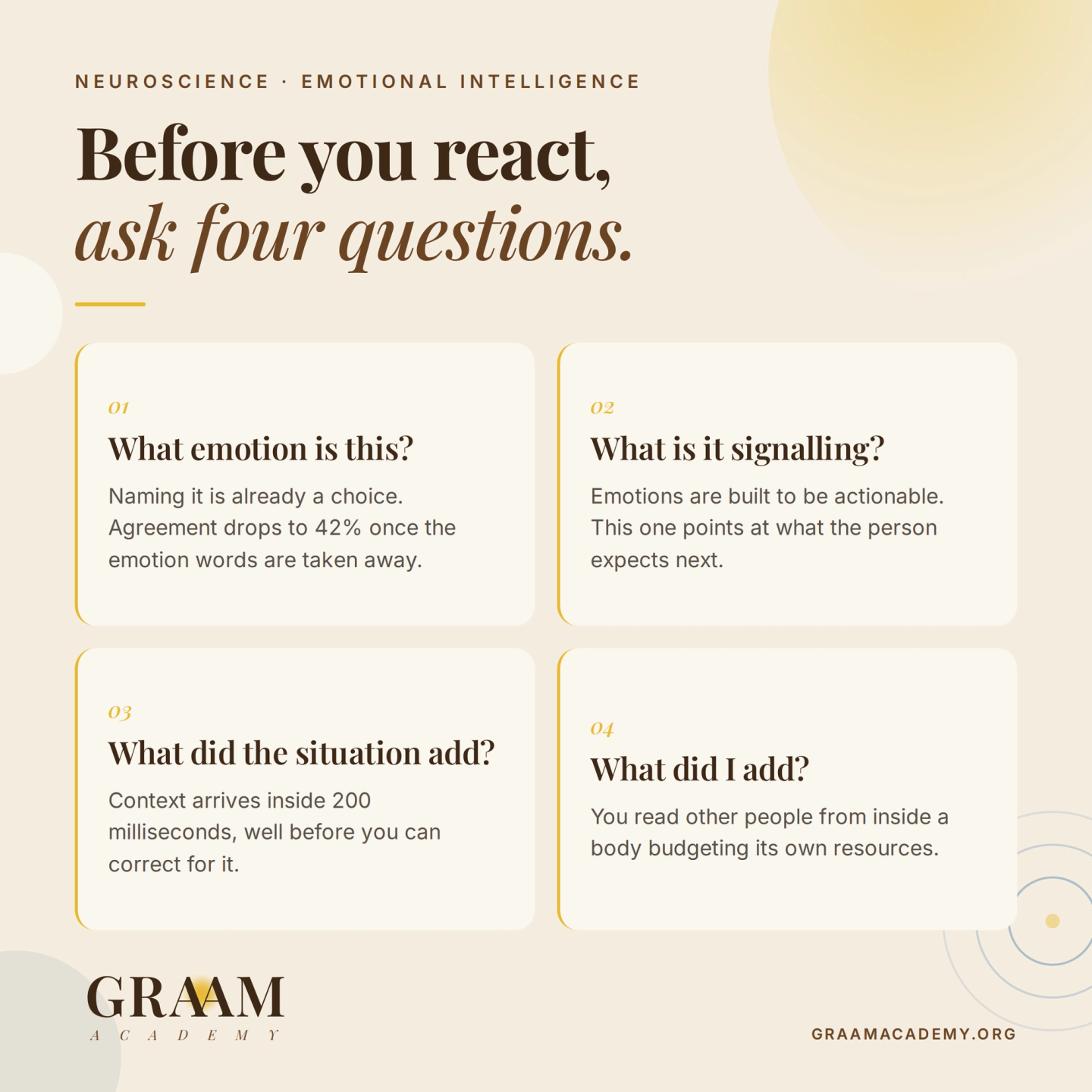
What emotion is this. Across studies of posed emotional faces, agreement with the intended label runs at about 57.7% when people supply their own words and 83.4% when they match against a list supplied to them, falls to 42% once the words are removed altogether, and drops to 36% when those words are temporarily stripped of meaning by repeating them until they sound like nonsense. The size of that swing indicates how much of the judgement the vocabulary was carrying, which follows from Barrett's account of a brain that makes sense of a situation by applying a concept to it. The consequence in a calibration meeting is that a phrase such as "he is being difficult" arrives sounding like an observation when it is closer to a selection, and once it has been said aloud about someone it tends to stay attached to them.
What is it signalling. Barrett describes the brain's core job as running the body, anticipating what it will need before it needs it, with emotions constructed in service of that task: sensations are categorised so that they become actionable in a particular situation, which is precisely what gives them meaning. An emotion is therefore evidence about a prediction, so a report's irritation in a review is information about what they expect to happen next and to whom, rather than a fact about their character. The difference is a practical one, since "he is irritated" leaves a manager with nothing to work with, whereas "he expects this conversation to end badly for him" indicates how to open it.
What did the situation add. An identical scowling face is perceived as fearful beside a description of danger and as disgusted beside a body holding a soiled object, while a disgust face is perceived as proud beside a body raising its arms in triumph, and because these effects appear in the brain's encoding of a face within 200 milliseconds and survive cognitive load, they arrive well beyond the reach of deliberate correction. Since most teams in Hong Kong are cross-cultural, there is a further layer to account for: perceivers from Western contexts scan the eyes, nose and mouth while perceivers from East Asian contexts fixate primarily on the eyes, and because the diagnostic features of some expressions sit around the mouth, that difference alone changes what each person sees. Two managers on the same interview panel can therefore leave with different accounts of the same candidate without either of them having been careless.
What did I add. Barrett and Simmons describe the brain as running a continuous internal model of the body in the world whose central job is to anticipate and budget the body's resources, and because the regions issuing those predictions are poor at computing correction from incoming signals, they conclude that what you experience largely reflects what your brain predicts is going on inside your body, based on past experience. You therefore read other people from inside a body with a budget, and the reading shifts when that budget is tight, which is why the local wellbeing figures belong in a discussion about judgement. An AIA survey of 804 Hong Kong adults in early 2026 found nearly 80% reporting emotional exhaustion, fatigue or demotivation, and PwC's Hong Kong survey found only 40% satisfied at work, which suggests managers are producing their least reliable reads during exactly the weeks that contain the most decisions.
Why a bad read does not correct itself
None of this would be particularly expensive if misreads averaged out over time, and two features of the framework suggest that they do not.
The first is that the brain can close the gap between prediction and evidence in three different ways, by updating the prediction, by moving so as to produce the evidence it expected, or by changing what it attends to, and only the first of those amounts to learning. Applied to a manager, this means that deciding someone is defensive tends to produce a more careful opening, more held in reserve and less given away, which is a reliable recipe for the guarded conversation that was predicted in the first place. The read ends up confirmed by the behaviour it caused.
The second is that any correction still has to be allowed in. Barrett describes the brain's salience network as issuing precision signals, predictions about which prediction errors are worth attending to, and extending that to a team, which is an extension of the framework rather than a finding it reports, a group that has learned candour is costly will stop supplying the evidence that would have corrected the manager.
Between them, these two mechanisms describe a leader whose accuracy about people degrades steadily while their confidence does not, and the cost surfaces as attrition among the people who were misread, promotion of the people who were easiest to read, and a leadership team growing more certain of a picture that nobody is updating.
Where a leader starts
Take the manager from the start of this article, thirty seconds into the review, having settled on defensive. Four questions asked in that moment would have given them a different conversation.
- I have called this defensive. What else fits what I actually saw? Guarded, embarrassed and braced for bad news all look much the same from across a table.
- If they feel this, what do they think is coming? Someone who believes they are about to be managed out behaves almost exactly like someone being difficult.
- How much of this belongs to the room? The deadline, who else is sitting in, and the fact that these meetings always happen in the same office all leave marks on a person.
- What sort of day am I having? A read taken at six in the evening at the end of a bad quarter is not the same read as one taken on Tuesday morning.
Answering them requires no particular sensitivity, only the discipline of treating a read as a first draft, which happens to be the habit that fast and confident readers of people most often lack. It is also the reason this is trainable in a way temperament is not: a 2024 meta-analysis of emotional intelligence training found real effects across randomised trials, albeit with wide confidence intervals and the authors' own caution that those effects may be overstated. How that training should be designed is the subject of the next article in this series.
References:
- Barrett, L. F., Mesquita, B., & Gendron, M. (2011). Context in emotion perception. Current Directions in Psychological Science, 20(5), 286–290.
- Barrett, L. F. (2017). The theory of constructed emotion: an active inference account of interoception and categorization. Social Cognitive and Affective Neuroscience, 12(1), 1–23.
- Barrett, L. F., & Simmons, W. K. (2015). Interoceptive predictions in the brain. Nature Reviews Neuroscience, 16(7), 419–429. Doğru, Ç. (2022). A meta-analysis of the relationships between emotional intelligence and employee outcomes. Frontiers in Psychology, 13, 611348.
- Powell, C., et al. (2024). Emotional intelligence training among the healthcare workforce: a systematic review and meta-analysis. Frontiers in Psychology, 15, 1437035.
- World Economic Forum, Future of Jobs Report 2025.
- OECD, The OECD AI Exposure Measure (2026).
- Microsoft Research, Working with AI (2025).
- Hong Kong Institute of Human Resource Management, Training and Development Needs Survey 2026.
- PwC Hong Kong, Workforce Hopes and Fears Survey 2025. AIA Hong Kong Workplace Wellbeing Survey 2026.
Learn More
We deliver focused training on every topic we write about.
Contact Us