Why Criticism Fails at Work: Three Timeless Principles for Better Workplace Communication
Criticism triggers defensiveness, sincere appreciation builds trust, and influence begins with understanding what the other person wants. Drawing on Dale Carnegie's classic and recent positive psychology research, this article shows how to practise all three in everyday workplace communication.
Think of the last piece of criticism you received at work. Chances are you remember exactly who said it, how it was phrased, and how it made you feel. Now try to remember whether it actually changed what you did.
For most of us, the honest answer is: not much. And that gap, between how sharply criticism lands and how little it changes, is where Dale Carnegie began his classic How to Win Friends and Influence People in 1936. The book is often filed under sales technique. Read closely, it is really a book about professional communication, and its first three principles remain some of the most practical guidance available for anyone who works with other people.
We work with people, not with logic
Carnegie's starting point is a sentence worth keeping close: when dealing with people, we are not dealing with creatures of logic. We are dealing with creatures of emotion, moved by pride, shaped by their own sense of importance.
This is why criticism so rarely works. The moment we criticise, the other person's attention does not go to the problem. It goes to their own defence. They justify, they explain, they quietly resent. The issue we wanted to fix stays exactly where it was, and the relationship now carries a small wound that was not there before.
Behavioural science backs this up. Decades of research on learning show that positive reinforcement changes behaviour far more reliably than punishment. Rewarding what goes right teaches; punishing what goes wrong mostly teaches avoidance and fear. People are no different. Criticism does not produce lasting change. It produces defensiveness, and defensiveness is where learning stops.
Carnegie's own model was Benjamin Franklin, who credited his diplomatic success to one discipline: he would speak ill of no one, and speak all the good he knew of everybody. That restraint was not weakness. As Carnegie put it, any fool can criticise, condemn and complain, and most fools do. Understanding and forgiving take character and self-control. Thomas Carlyle made the same point from another angle: a great person shows their greatness by how they treat those with less power. In a workplace, that means the intern, the new joiner, the colleague who cannot fight back. And it includes what we say when they are not in the room. Speaking behind people's backs is simply criticism with the defensiveness delayed.
The practical shift is a single question. Before you point out a fault, pause and ask yourself: can I say this differently? Can I reframe it from a place of understanding, growth and care? The concern still gets raised. What changes is whether the other person can actually hear it.
Appreciation is a professional skill, not a nicety
Carnegie's second principle sounds soft until you look at what it does. Honest and sincere appreciation meets one of the deepest human needs there is: the need to feel important, to know that what we do matters to someone.
Notice the two conditions. Honest, and sincere. This is not flattery, which people detect instantly and discount just as fast. It is the discipline of noticing what someone genuinely did well and telling them, specifically. Not a vague well done, but naming the thing: the way they handled a difficult client, the clarity of their report, the patience they showed a struggling teammate.
Appreciation restores self-esteem in the moment, and gratitude compounds over time. Colleagues who feel seen give more, stay longer, and extend more goodwill when things go wrong. If criticism is a withdrawal from the relationship, sincere appreciation is the deposit that makes the relationship worth investing in at all.
Modern research adds a dimension Carnegie could not have known: how you respond when someone shares good news matters as much as the appreciation you initiate. Psychologists call it capitalisation. In a landmark set of studies, Gable, Reis, Impett and Asher (2004) found that people shared their best event of the day with someone else on about seven days out of ten, and that on those days their mood and life satisfaction were higher than the event alone could explain. But the benefit hinged on the listener. Of four typical response styles, only one, responding with active interest and genuine questions, was linked to stronger, more trusting relationships. Quietly nodding along, pointing out the downsides, and changing the subject all quietly damaged them.
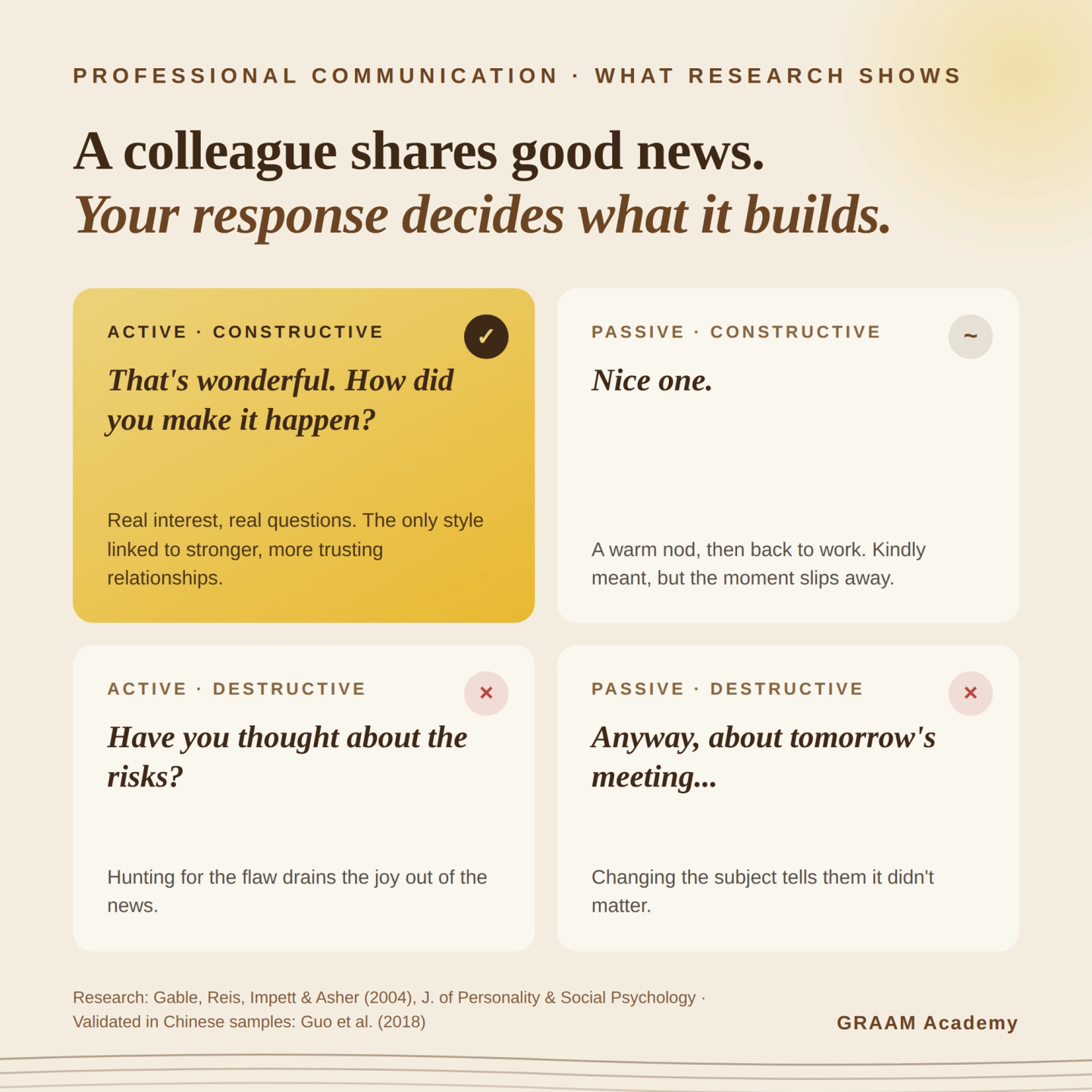
The same framework holds in Chinese contexts. A Beijing Normal University team validated the Chinese version of the scale with over 1,200 participants and replicated all four response styles, with one cultural nuance: quiet, understated support also carried positive weight for Chinese respondents (Guo, Lin, Cheng & Liu, 2018). Restraint, in other words, can still read as care in a Chinese workplace. Indifference and cold water cannot. So when a colleague brings you good news, the highest-value move costs seconds: stop what you are doing, show interest, and ask one real question.
Influence starts from what the other person wants
The third principle is the one most people get backwards. When we want to persuade, our instinct is to talk about what we want: my deadline, my project, my reasons. Carnegie's advice is to flip it. Action springs from what a person fundamentally desires. So the only reliable way to influence someone is to talk about what they want, and show them how to get it.
He called it arousing an eager want in the other person, and it is not manipulation. Manipulation is getting someone to act against their own interest. This is the opposite: doing the work of understanding their interest before you open your mouth.
In practice, it means one preparation step before any important conversation:
- Before asking a colleague to adopt your process, ask yourself what they are trying to achieve this quarter, and connect your request to it.
- Before pitching a client, set aside your features and start from their problem.
- Before asking your team for extra effort, be able to say clearly what is in it for them, whether that is growth, recognition or simply work they can be proud of.
If you cannot answer the question what does this person want, you are not ready to persuade them.
Old principles, daily practice
None of these three principles is complicated. What makes them rare is that under pressure, we default to the opposite: we criticise when frustrated, forget to appreciate when busy, and argue from our own point of view when we need something. Better communication is less about learning new techniques than about practising old ones until they hold up under stress.
That is exactly what we work on in GRAAM Academy's professional communication workshops: turning these principles into concrete habits of language that teams can use in feedback, in meetings, and in the conversations that matter most. Carnegie wrote his book in 1936. The people around us have not changed since. That is precisely why it still works.
References:
- Carnegie, D. (1936). How to Win Friends and Influence People.
- Gable, S. L., Reis, H. T., Impett, E. A. & Asher, E. R. (2004). What Do You Do When Things Go Right? The Intrapersonal and Interpersonal Benefits of Sharing Positive Events. Journal of Personality and Social Psychology.
- Guo, W., Lin, Z., Cheng, N. & Liu, X. (2018). Psychometric Properties of the Chinese Perceived Responses to Capitalization Attempts Scale. Social Behavior and Personality.
Learn More
We deliver focused training on every topic we write about.
Contact Us