Purpose and Meaning: Why the Two Are Not Interchangeable
This article explains the difference between purpose and meaning, where the two overlap, and why schools and organisations that build one should not assume they have built the other
In everyday use, purpose and meaning are close to interchangeable. Ask a teacher or a manager what gives their work purpose, and the answer will usually describe what makes it meaningful. For most of the field's history, psychological research measured the two together as well, and that habit continues to shape how programmes are designed and how their outcomes are assessed.
How the two constructs became conflated
Much of the modern study of purpose traces back to Viktor Frankl, whose work did not separate purpose from meaning. The questionnaires built on his ideas carried the same assumption. Martela and Steger (2016) point out that widely used instruments mix items about understanding one's life, such as "I understand my life's meaning," with items about direction, such as "My life has a clear sense of purpose," and then sum them into a single score, so none of the common scales can examine the facets separately.
Hong Kong youth research has relied mainly on the Chinese version of the Purpose in Life Questionnaire, which treats the two as one construct (Shek, 2012). Young people describe them the same way. In one focus-group study, 39 of 57 Hong Kong secondary students equated both meaning and purpose with having a career plan and working toward it (Yuen et al., 2020).
Distinguishing purpose from meaning
Reviewing the literature, Rainey (2014) identifies two features that distinguish the constructs.
The first is orientation. Meaning is cognitive. Baumeister and Vohs (2002) describe it as connection: the human ability to link events, memories, people and ideas into something coherent. It gives a person the feeling that life makes sense (Heintzelman & King, 2014). Purpose is motivational. It prompts action rather than comprehension. Frankl himself wrote that the response to life's tasks must consist "not in talk and meditation, but in right action and right conduct." A person can understand their life well and still not know what to do next.
The second is time. Meaning draws on the past and the present. People find or make meaning by reappraising earlier events and connecting them to current experience. Purpose connects the present to the future, so that the future guides what a person does now (McKnight & Kashdan, 2009; Steger, 2012). Rainey summarises the contrast plainly: purpose is temporally bound to the future, while meaning is temporally bound to the past.
The three facets of meaning
Martela and Steger (2016) address the question by examining the structure of meaning itself. They argue that when people say their life is meaningful, they may be referring to any of three things:
- Coherence: a sense that one's life is comprehensible and makes sense.
- Purpose: a sense of core goals, aims and direction.
- Significance: a sense that one's life has value and is worth living.
In this model, purpose is one facet of meaning rather than a synonym for it. Coherence belongs to understanding, purpose to motivation, and significance to evaluation. The opposite of each is different too: uncertainty, aimlessness, and an absence of value.
The definition of purpose used in youth development research narrows the construct further. Damon, Menon and Bronk (2003) define it as a long-term goal that is personally meaningful and that also contributes to the world beyond the self. Personal meaningfulness sits inside this definition as one of three dimensions. A goal can be deeply meaningful to a person and still fall short of purpose if it carries no intention to contribute to anyone else.
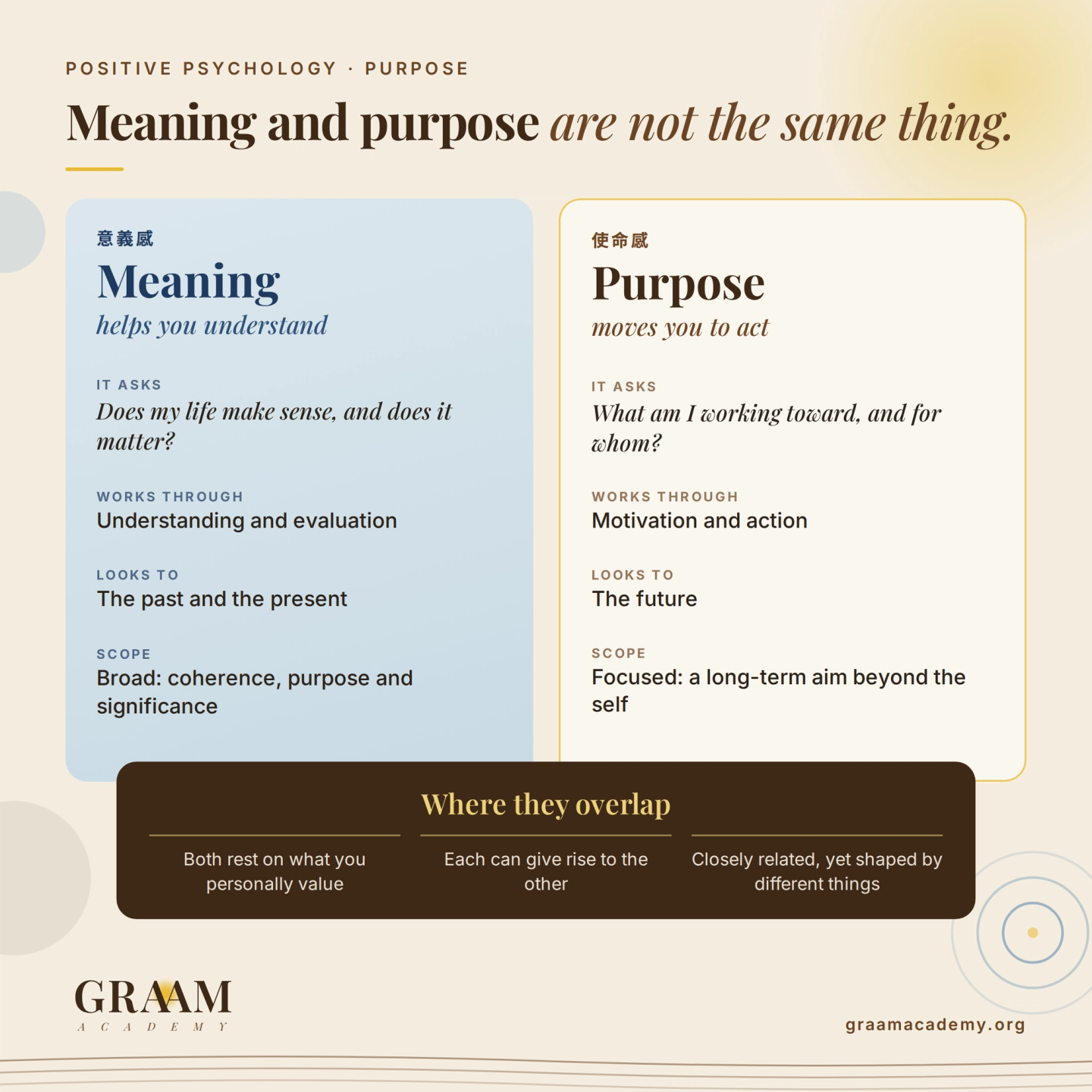
The relationship between the Purpose and Meaning
Separating the constructs does not make them independent. The literature describes three connections between them.
McKnight and Kashdan (2009) propose that purpose first grows out of meaning and then becomes a self-sustaining source of it through continued goal pursuit. Frankl, Steger and Baumeister describe the reverse sequence. Rainey concludes that the relationship is best treated as bi-directional.
Before a person can choose an aim, they need some understanding of their own capacities and of what needs doing in the world, which leads Martela and Steger to suggest that coherence creates the field from which people draw their purposes. Acting on a purpose then teaches people about themselves. Their example is someone who adopts climate action as a purpose, and months later is still driving to the nearest fast-food outlet every day; the mismatch is useful information about what they actually care about.
George and Park (2013) built separate scales for purpose and for general meaning and followed people over time. The two scores were strongly related, yet had different predictors. Religiousness and spirituality predicted later meaning but not purpose. Optimism predicted later purpose but not meaning. The authors read this as empirical support for treating the two as distinct constructs. It also suggests that what feeds one will not automatically feed the other.
Implications for schools and organisations
Reflection exercises, storytelling and values discussions help participants make sense of their experience; they are worthwhile, and what they build is coherence. Purpose requires a further step: a long-term aim, and real opportunities to act on it for the benefit of someone else. Efforts that target meaning broadly will not necessarily cultivate purpose or its beyond-the-self dimension.
The confusion carries into assessment: a questionnaire that combines purpose and meaning into one score, which is how Hong Kong youth research has usually measured them, cannot show a school whether purpose in particular is developing. Instruments that measure purpose as a distinct, three-part construct now exist; the Claremont Purpose Scale has a Chinese version validated for use with youth (Wang et al., 2023).
In workplaces, an employee may find their work coherent and valuable and still have no sense of where they are heading. Another may have a clear five-year target and no account of why it matters. The first needs direction; the second needs sense-making. A single engagement question about meaningful work cannot tell these two people apart.
For a school or an HR team reviewing an existing programme, three questions help locate what it is actually building:
- Does it help participants understand their experience, or decide what to do next?
- Does it look mainly backward, or does it ask participants to commit to something ahead of them?
- Does the aim it produces benefit anyone beyond the participant?
Bringing it to your school or organisation
GRAAM Academy designs purpose work with this distinction in mind. Reflection comes first, so that participants have a coherent account of who they are and what they value. The programme then moves to long-term aims and to structured opportunities to act on them for others, and measures purpose separately from general meaning so that progress in each is visible.
References:
- Baumeister, R. F., & Vohs, K. D. (2002). The pursuit of meaningfulness in life. In C. R. Snyder & S. J. Lopez (Eds.), Handbook of Positive Psychology. Oxford University Press.
- Bronk, K. C., et al. (2023), as cited in Ma (2026).
- Damon, W., Menon, J., & Bronk, K. C. (2003). The development of purpose during adolescence. Applied Developmental Science, 7(3), 119–128.
- Frankl, V. E. (1963). Man's Search for Meaning. George, L. S., & Park, C. L. (2013). Are meaning and purpose distinct? The Journal of Positive Psychology, 8, 365–375.
- Heintzelman, S. J., & King, L. A. (2014). (The feeling of) meaning-as-information. Personality and Social Psychology Review, 18(2), 153–167.
- Martela, F., & Steger, M. F. (2016). The three meanings of meaning in life: Distinguishing coherence, purpose, and significance. The Journal of Positive Psychology, 11(5), 531–545.
- McKnight, P. E., & Kashdan, T. B. (2009). Purpose in life as a system that creates and sustains health and well-being. Review of General Psychology, 13(3), 242–251.
- Rainey, L. (2014). The Search for Purpose in Life: An Exploration of Purpose, the Search Process, and Purpose Anxiety. MAPP capstone, University of Pennsylvania.
- Shek, D. T. L. (2012); Yuen et al. (2020); Wang et al. (2023), as cited in Ma (2026).
Learn More
We deliver focused training on every topic we write about.
Contact Us