Purpose, Identity and Reflection: How Young People Find a Direction
This article examines the relationship between purpose and identity development, the evidence for structured reflection as a means of building purpose, and why direct questioning about purpose is generally the least effective approach.
About one in ten early adolescents, one in five late adolescents and one in three university-age young people report a clear sense of purpose in life (Damon, 2008).
Nearly all of them will establish a sense of identity. The gap between near-universal identity formation and comparatively rare purpose development is where schools and youth programmes have the greatest opportunity to intervene.
Defining purpose
A purpose is a long-term, forward-looking intention to accomplish something that is meaningful to the self and of consequence to the world beyond the self (Damon, Menon, & Bronk, 2003).
- The aim is distant, and its value lies in the direction it provides for nearer goals.
- It must be personally meaningful to a degree that is visible in behaviour, since individuals invest time and energy in pursuing a purpose rather than only contemplating one.
- An aim that extends beyond the self distinguishes purpose from a private sense of meaning and accounts for much of the benefit associated with the construct.
This is a demanding definition, which explains both why so few young people meet it. It also means that a purpose cannot be assigned in the way a goal can, since it functions only once the young person recognises it as their own.
Purpose and identity development
The question of who you are becomes urgent during adolescence.
Erikson identified identity formation as the central developmental task of adolescence, and contemporary research continues to regard its resolution as the defining milestone of the adolescent and young adult years. Purpose development is linked to that process in two respects. Both depend on cognitive capacities that emerge at the same stage, and once both are present, each supports the development of the other.
Abstract, hypothetical reasoning develops during the second decade of life, which is why an enduring purpose rarely appears before then. Younger children engage in activities that are meaningful to them, but holding a purpose requires reasoning about a self that does not yet exist and a world that has not yet arrived, which is beyond their cognitive reach at that age (Bronk & Mitchell, 2020).
Then purpose and identity start feeding each other. Bronk (2011) followed eight adolescents with unusually clear purposes, interviewing each for approximately three hours every other year over five years. Participants described purpose as clarifying their place in the world.
A sixteen-year-old committed to environmental work described finding "my place in the world... this is the job I'm supposed to be performing." A twelve-year-old raising funds to build wells described the world as a puzzle in which "we have to try to figure out where our pieces fit."
The relationship also operated in the reverse direction. As these young people became known for their commitments, others began to identify them accordingly, and that recognition reinforced the commitment. The environmentalist and her friends became "the tree huggers at school," and a young musician observed that he was introduced as the one who played jazz piano rather than as the one who was good at mathematics, adding, "I identified with it." Bronk interprets this through self-perception theory: individuals infer their own beliefs partly by observing their repeated behaviour, and those around them confirm the inference.
Purpose therefore tends to precede identity and to give it direction, while identity subsequently sustains the purpose rather than generating it. This is the sense in which identity formation is a key step, since it is what makes a direction durable.
The practical implication is that young people should be given the opportunity to act on their commitments, and that those commitments should then be named explicitly by the adults around them.
The evidence on structured reflection
A research team interviewed adolescents about what mattered most to them for the purposes of data collection. Several months later, the interviewed group scored significantly higher on measures of purpose than participants who had not been interviewed (Bundick, 2011). The interview lasted approximately forty-five minutes and had not been designed as an intervention.
Bronk and colleagues subsequently developed this finding into a designed intervention, constructing two short online courses of three sessions each, fifteen to twenty minutes per session across one week, and testing them against a memory-technique control condition with 224 young adults. Both courses produced significant increases in participants' sense of purpose relative to the control group, and the gain in identified purpose was maintained one week later. The activities indicate the form of reflection involved:
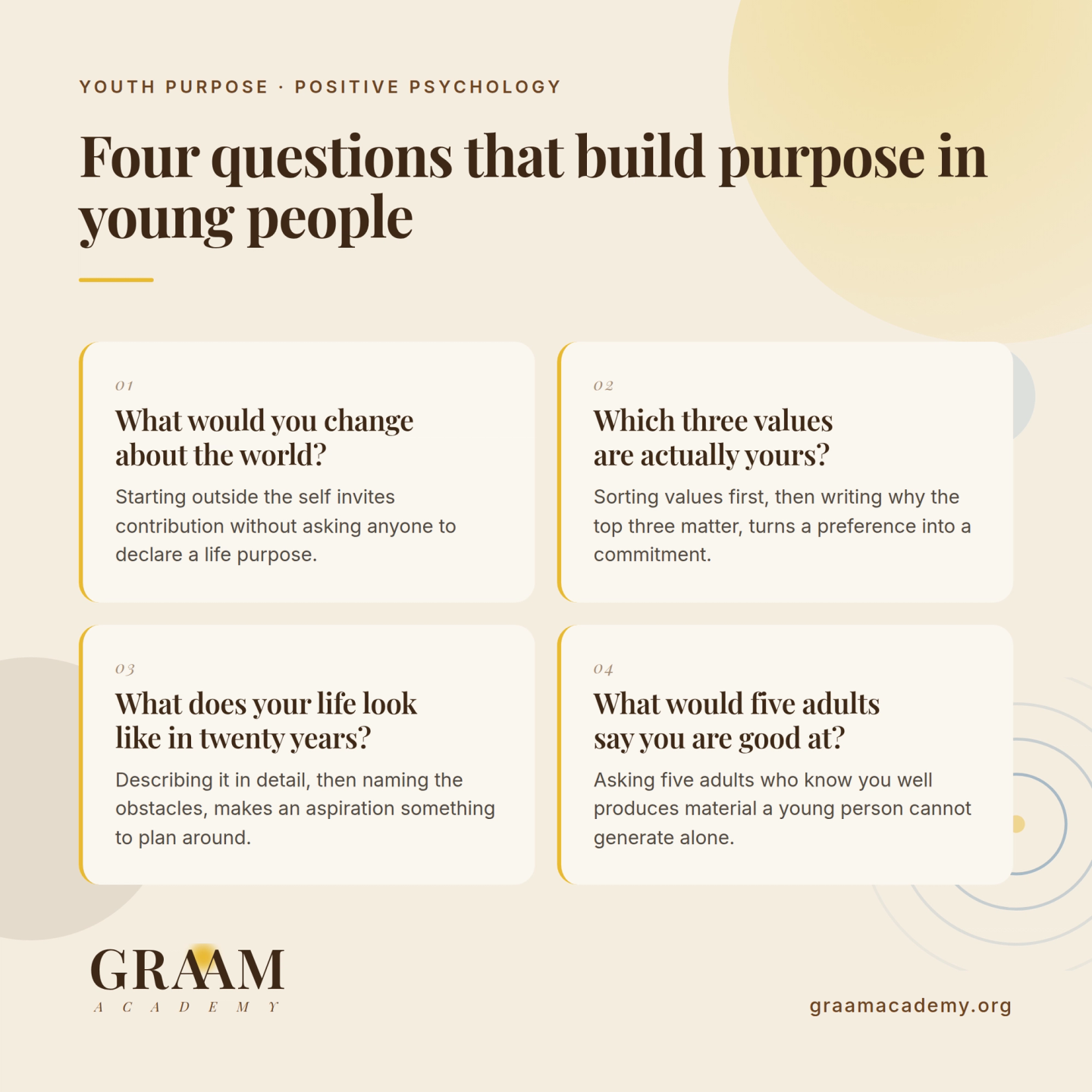
- Questions directed outward rather than inward. Participants were asked what they would change if they could change anything about the world, what an ideal world would look like, and what they could do to move the world closer to it. The sequence invites consideration of contribution without requiring a declaration of life purpose.
- Values sorted before they are discussed. A card sort of values such as caring for family, contributing to the community or creating something new, followed by written explanation of why the top three matter and how they shape future plans.
- Extended future projection. A best-possible-selves exercise imagining life twenty years ahead in detail, followed by identification of the obstacles likely to arise.
- Third-party input from five adults. Participants who could not identify how they might contribute emailed five adults who knew them well with three questions: what do you think I really enjoy doing, what do you think I am particularly good at, and how do you think I will leave my mark. The responses supplied material the participants could not generate independently.
The final exercise operationalises the identity mechanism described above, since hearing what one is known for, from people with close knowledge, contributes to how a young person consolidates a sense of self.
Why direct questioning is less effective
The gratitude course raised participants' sense of purpose more than the purpose course did.
Being asked to reflect directly on one's purpose is intimidating for a young person who has not yet identified one, whereas being reminded of what one has received provides a less demanding route into considering what one wishes to contribute. Experiences of awe appear to function in a similar way, by directing attention outward.
This is a useful correction for anyone running a session. A workshop called "find your purpose" puts the heaviest pressure on the students with the least idea, who are the ones it was designed for. The same group will engage more readily with questions about gratitude, or about what they would change in the world.
Hardship builds purpose only when there is support around it
Two secondary schools in southern California, one serving a mainly low-income community and one a mainly middle-income community, produced the same rate of purpose. What differed was how the young people got there (Bronk, Mitchell, Hite, Mehoke, & Cheung, 2020).
More than half the low-income students reported reaching purpose through hardship, including financial difficulty, racial and gender bias, and illness. For many of them the hardship became the source of the purpose rather than an obstacle to it, but this occurred only under two conditions:
- the young person could connect a past hardship to a possible future action
- they had access to developmental assets, most often family support, like-minded peers and a religious belief system.
This also applies in the middle-income sample.
Programmes should therefore help young people identify personally significant ways of addressing the difficulties in their lives rather than designing around them. The developmental assets are equally important, since hardship alone produced no purpose in this sample, whereas hardship accompanied by support sometimes did.
Implications for schools and organisations
Purpose can be cultivated. What remains unresolved is implementation at scale within the constraints of a school timetable. Four principles follow from the evidence.
Protect time for structured conversation. A forty-five-minute conversation about what matters produced measurable change several months later, a substantial return for a single period. The reflection requires structure and an attentive listener; distributing and collecting a worksheet does not produce the same effect.
Approach the topic indirectly. Questions about the world, about values and about gratitude elicit responses from students who do not respond to direct questions about purpose.
Name what is observed. Young people consolidated their sense of identity partly because adults and peers identified them by their commitments, and teachers, managers and coaches already occupy that position. Naming an observed pattern explicitly is a low-cost action with an established mechanism behind it.
Evaluate over years rather than terms. A purpose identified in late adolescence tends to remain stable into middle adulthood, so measurement by end-of-term engagement will consistently understate it.
Bringing it to your school or organisation
GRAAM Academy's purpose and identity work for young people is built on this research. It helps students examine what they already care about, gives them the language for it, and builds the reflective habits that turn an interest into a direction they can sustain.
Every young person is already carrying something worth building on., and the task is to help them recognise it and to help the adults around them name it.
References:
- Bronk, K. C. (2011). The role of purpose in life in healthy identity formation: A grounded model. New Directions for Youth Development, 2011(132), 31–44.
- Bronk, K. C., Baumsteiger, R., Mangan, S., Riches, B., Dubon, V., Benavides, C., & Bono, G. (2019). Fostering purpose among young adults: Effective online interventions. Journal of Character Education, 15(2), 21–38.
- Bronk, K. C., & Mitchell, C. (2020). Youth purpose: A translational research agenda. In A. L. Burrow & P. L. Hill (Eds.), The Ecology of Purposeful Living Across the Lifespan (pp. 233–248). Springer.
- Bronk, K. C., Mitchell, C., Hite, B., Mehoke, S., & Cheung, R. (2020). Purpose among youth from low-income backgrounds. Child Development.
- Bundick, M. J. (2011), reported in Bronk et al. (2019). Damon, W. (2008). The Path to Purpose. Free Press.
- Hill, P. L., Burrow, A. L., & Sumner, R. (2013). Addressing important questions in the field of adolescent purpose. Child Development Perspectives, 7(4), 232–236.
- Purpose definition per Damon, Menon, & Bronk (2003).
Learn More
We deliver focused training on every topic we write about.
Contact Us