Two Pathways to Help Young People Find Their Purpose
How character strengths build youth purpose. Explore two research-backed pathways and the hybrid model educators are using to support student development.
One of the deepest questions a young person can ask is why am I here?
Not in the existential, crisis-at-midnight sense, but in the grounded, everyday sense. What do I care about enough to give my effort to? What pulls me forward? What can I contribute to the world?
This is what researchers call purpose, and it may be one of the most underrated goals of education.
Developmental psychologist William Damon defines purpose as the intention to contribute to the world beyond the self in personally meaningful ways (Damon et al., 2003). It is not a job title or a five-year plan. It is a felt sense of direction, the because behind the what.
The evidence for why this matters is striking. Young people with a stronger sense of purpose show better academic performance (Minehan et al., 2000; Pizzolato et al., 2011), lower rates of substance abuse (Abramoski et al., 2018), higher levels of hope and agency (Hill et al., 2013; Bronk et al., 2009), and stronger identity formation during adolescence (Bronk, 2011).
So the question becomes: how do we cultivate it?
One of the most promising frontiers in positive education is the intersection of character strengths and youth purpose, and there are two distinct pathways worth understanding.
A Common Language for Uncommon Potential
Before exploring the two pathways, it helps to understand what character strengths are and why they matter in this conversation.
The VIA Classification identifies 24 character strengths, qualities like hope, curiosity, perseverance, love, and creativity, that represent universally valued positive traits. They are not talents or skills. They are the authentic expressions of who we are at our best.
Research by Bronk (2024) suggests that purpose and character are mutually reinforcing. A sense of purpose provides an ultimate direction for one's actions, while character strengths serve as the fuel and tools for pursuing that direction. They need each other.
The question is which strengths to focus on, and how.
Pathway One: The Prescriptive Approach
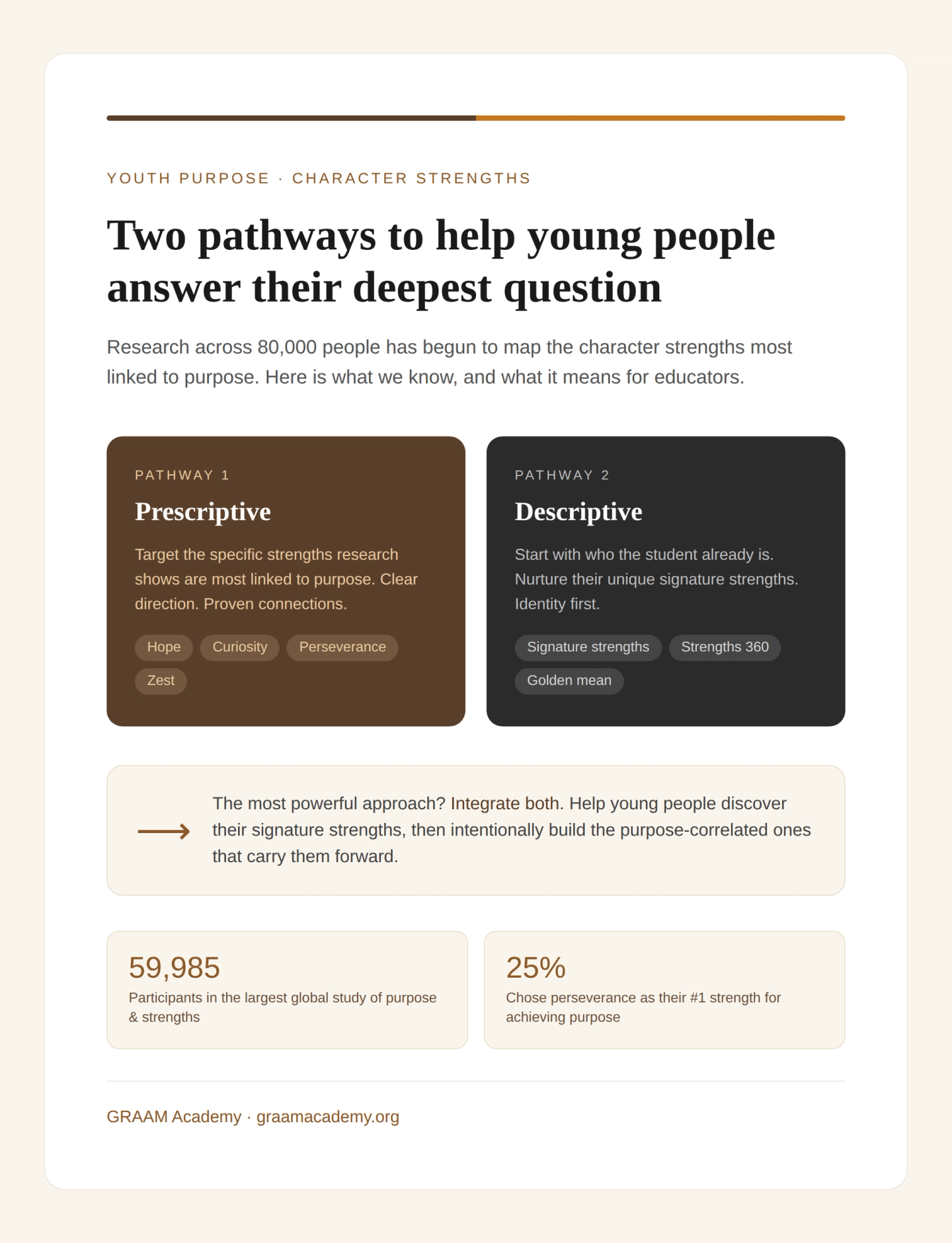
The prescriptive approach is straightforward. Identify the specific character strengths that are most strongly linked to purpose, and intentionally cultivate those.
Two landmark studies provide compelling direction here.
In the largest global study of purpose and character strengths, with a sample of 59,985 participants, Weziak-Bialowolska et al. (2023) found that five strengths had the largest effect sizes on purpose:
Hope. Spirituality. Zest. Perseverance. Curiosity.
A second study by Russo-Netzer et al. (2023) with 20,000 participants reinforced these findings. When participants were asked which strengths most helped them pursue valued goals and experience a sense of purpose, the top five were perseverance, love of learning, curiosity, love, and hope.
Perseverance was chosen by 25% of participants, making it the most frequently cited strength for purpose. The reasoning was that purpose is not just a feeling. It requires the sustained effort to keep going when things are hard. Curiosity, meanwhile, helps young people better understand the people around them and the world they want to serve.
What This Looks Like in Practice
A prescriptive approach in a school setting might involve targeted workshops focused on building hope, curiosity, and perseverance. It can include goal-setting practices rooted in the language of these purpose-correlated strengths, reflection exercises that help students connect their efforts to something larger than themselves, and mentoring conversations where educators help students name how these strengths appear in their lives.
The strength of this approach is its clarity and direction. For educators working with limited time and resources, knowing which strengths to prioritise is enormously helpful.
Pathway Two: The Descriptive Approach
The descriptive approach takes a different starting point. Every student already has a unique constellation of strengths, and the work begins with discovering and honouring what is already there.
Rather than starting with a prescribed set of "important" traits, the descriptive approach begins with the individual, their particular profile of signature strengths, and works outward from there (Linkins et al., 2015).
This matters because signature strengths are not just things we are good at. They are qualities that feel natural, energising, and deeply personal, core to who we are. When young people are given a language for these qualities and supported to use them intentionally, they begin to see themselves differently.
Two practices from Linkins et al. (2015) are particularly powerful for schools.
The first is Strengths 360. Students invite five people in their lives, perhaps a parent, a teacher, a friend, a sibling, a coach, to offer specific observations about their strengths. This multi-perspective view helps students recognise qualities in themselves they may have overlooked, and builds a richer, more textured sense of identity.
The second is Signature Strengths Across Settings. Students create a concrete plan for applying their signature strengths in both school and non-school contexts, and then reflect on what changes as a result. This bridges the gap between self-knowledge and action.
The Golden Mean: The Art of Balanced Strengths Use
The descriptive approach also introduces an important concept called the golden mean. Every strength can be overused or underused, and wisdom lies in finding its optimal expression in each situation (Niemiec, 2019).
Research on meaning and calling illuminates this idea. Allan (2015) found that pairs of strengths, such as honesty and kindness, or hope and gratitude, had the strongest relationship to meaning in life when both were expressed in a balanced manner, not in isolation. Harzer and Ruch (2012) discovered that only those who applied four or more signature strengths in their work reported experiencing it as a calling.
The implication is that purpose is not built on one defining strength. It emerges from a rich, balanced, intentional engagement with who we fully are.
The Case for a Hybrid Model
Both pathways are promising. Both are incomplete on their own.
The prescriptive approach tells us where to aim, which strengths correlate most powerfully with purpose. But it risks becoming a one-size-fits-all solution that overlooks the individual.
The descriptive approach honours the unique identity of every young person. But without a clear destination in mind, it can be hard to know what we are building toward.
The most exciting frontier in character strengths education lies in integrating both:
Help young people discover and celebrate their signature strengths. Then, within that rich self-knowledge, intentionally develop the purpose-correlated strengths of hope, curiosity, and perseverance that will carry them forward.
This is the hybrid model. Identity-rooted, purpose-directed, and deeply personal.
A Note on the Research Gap
It is worth being honest about what we do not yet know.
Both major studies on purpose-correlated strengths (Weziak-Bialowolska et al., 2023; Russo-Netzer et al., 2023) are cross-sectional, meaning they capture a single moment in time, not a before-and-after journey. We cannot yet say definitively that cultivating hope causes more purpose. It may be that young people who already have a strong sense of purpose naturally express more hope and curiosity.
Additionally, young people are underrepresented in this research. The 2023 Weziak-Bialowolska study included no participants under 18. Only 2% of the Russo-Netzer sample were under 17.
This is not a reason for pessimism. It is a call to action for practitioners and researchers, particularly those working directly with young people, to design richer, longitudinal programmes and document what happens over time.
At GRAAM Academy, this kind of rigorous, youth-centred inquiry is at the heart of what we are building.
What Can Educators Do Today?
You do not need to wait for the perfect longitudinal study to start meaningful work. Here are three practical entry points.
1. Start with strengths discovery. Invite your students to complete the free VIA Youth Survey for ages 10 to 17. Spend time helping them understand their top strengths, not as labels, but as living, contextual qualities.
2. Connect strengths to contribution. Ask: When you use your strength of curiosity (or perseverance, or kindness), who benefits? How does the world feel different? This question begins to bridge individual strengths and beyond-the-self purpose.
3. Build hope intentionally. Hope is not a feeling. It is a thinking style. It involves believing that good futures are possible and that we have the pathways and agency to get there (Snyder, 2002). Incorporate hope-based practices: goal setting, obstacle anticipation, and pathway thinking.
Conclusion
Whether we begin with a map of purpose-correlated strengths or with the unique signature of an individual student, we are working toward the same destination. A young person who knows who they are, what they care about, and what they have to give.
That is not a small thing. In a world that often asks young people to compete rather than contribute, to perform rather than belong, helping them find their purpose through their character may be one of the most meaningful and hopeful things we can do.
GRAAM Academy offers training programmes in Positive Psychology and AI-powered tools for schools and organisations. Learn more at graamacademy.org.
References
- Allan, B. A. (2015). Balance among character strengths and meaning in life. Journal of Happiness Studies, 16(5), 1247–1261.
- Bronk, K. C. (2011). The role of purpose in life in healthy identity formation. New Directions for Youth Development, 2011(132), 31–44.
- Bronk, K. C. (2024). Purpose through the lens of character virtue development. In M. D. Matthews & R. M. Lerner (Eds.), The Routledge International Handbook of Multidisciplinary Perspectives on Character Development.
- Bronk, K. C., et al. (2009). Purpose, hope, and life satisfaction in three age groups. The Journal of Positive Psychology, 4(6), 500–510.
- Damon, W., Menon, J., & Bronk, K. C. (2003). The development of purpose during adolescence. Applied Developmental Science, 7(3), 119–128.
- Harzer, C., & Ruch, W. (2012). When the job is a calling. The Journal of Positive Psychology, 7(5), 362–371.
- Hill, P. L., Burrow, A. L., & Sumner, R. (2013). Addressing important questions in the field of adolescent purpose. Child Development Perspectives, 7(4), 232–236.
- Linkins, M., et al. (2015). Through the lens of strength. The Journal of Positive Psychology, 10(1), 64–68.
- Minehan, J. A., et al. (2000). Predictors of adolescent drug use. Journal of Child & Adolescent Substance Abuse, 10(2), 33–52.
- Niemiec, R. M. (2018). Character strengths interventions. Hogrefe.
- Niemiec, R. M. (2019). Finding the golden mean. Counselling Psychology Quarterly, 32(3–4), 453–471.
- Pizzolato, J. E., et al. (2011). Purpose plus: Supporting youth purpose, control, and academic achievement. New Directions for Youth Development, 2011(132), 75–88.
- Russo-Netzer, P., Tarrasch, R., & Niemiec, R. M. (2023). A meaningful synergy. Social Sciences, 12(9), 494.
- Weziak-Bialowolska, D., Bialowolski, P., & Niemiec, R. M. (2023). Character strengths and health-related quality of life. Journal of Research in Personality, 103, Article 104338.
Learn More
We deliver focused training on every topic we write about.
Contact Us