When Work Becomes a Calling: What Japan's 天職 Teaches Us About Purpose
When Work Becomes a Calling: What Japan's 天職 Teaches Us About Purpose
On a narrow street in Tokyo, a ramen shop owner wipes down his counter between customers. Not a quick pass. A careful one. He straightens each bowl, checks the broth, greets the next guest with a small nod. Nearby, a bus driver does something similar: white gloves on the wheel, a slight bow to passengers, every stop announced with the seriousness of someone reading the evening news.

Visitors arrive in Japan expecting beauty and order. What tends to stay with them is something quieter, the way small scenes like these reframe what work can be.
What stands out is not efficiency. It is respect. Respect for the people being served, for the space, and for the task itself, however ordinary. The bowl of ramen matters. The bus route matters. And the person doing the work seems to know it.
A word for it: 天職
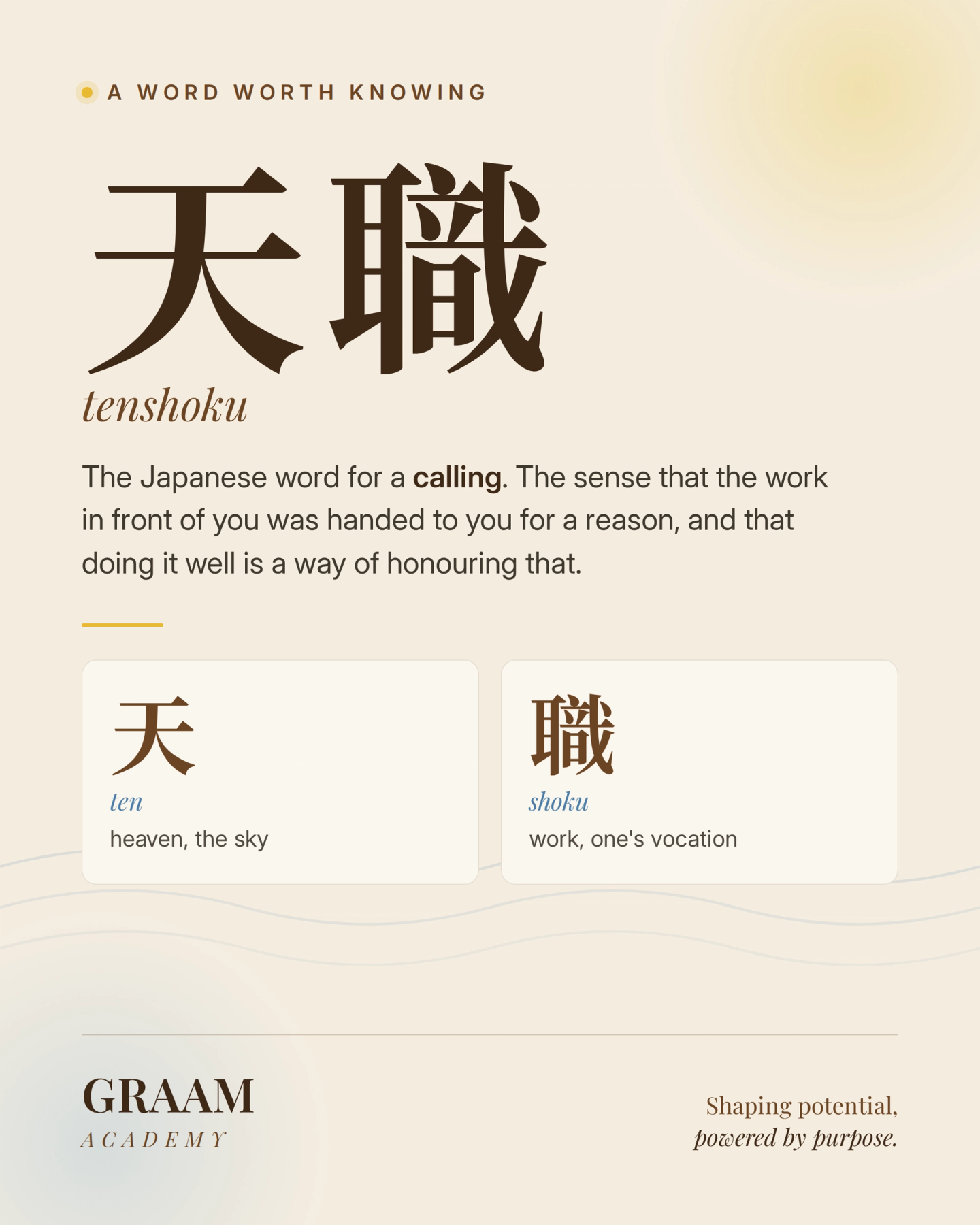
There is a word for what these scenes reveal. 天職, tenshoku, written with the characters for heaven and work. It translates as vocation, lifework, or calling. The sense beneath it is that the work in front of you was given to you for a reason, and that doing it well is a way of honouring that.
In Hong Kong, a different phrase does the work. 搵食. Literally, looking for food. It is honest, and warm in its own blunt way, but the message is unmistakable. Work is how we eat. A means, rarely a meaning.
搵食 looks for a living. 天職 answers a calling. Most people spend their careers somewhere between the two.
Sitting under tenshoku is an older idea: 職人, shokunin, the craftsman. The shokunin spirit holds that no honest work is beneath dignity, as long as it is done with care and offered to the people it serves. A custodian and a sushi master can both be shokunin. The honour lives in the doing, not in the title.
What the research actually says
This is more than cultural admiration. Decades of psychology describe the very difference these scenes capture.
In a study that reshaped how we understand work, Amy Wrzesniewski and her colleagues found that people relate to the same job in three distinct ways. Some experience it as a job, a source of income. Some experience it as a career, a track for advancement and status. And some experience it as a calling, work that is worth doing for its own sake and that contributes to something beyond the self (Wrzesniewski et al., 1997). People who hold a calling orientation tend to stay in their roles longer, take fewer absence days, and report greater satisfaction.
Why do some people arrive at a calling while others stall at a paycheck? Part of the answer lives in how psychologists define purpose. William Damon and colleagues describe purpose as a stable intention to accomplish something that is at once meaningful to the self and consequential for the world beyond the self (Damon et al., 2003). Three elements have to be present together. A long-term goal one is moving toward. A sense that the goal genuinely matters. And a reach beyond the self, the feeling that what one does serves others.
This is the frame that makes the contrast click into place. Hong Kong is excellent at the first element. Goals get set, work gets done, and people measure themselves against those goals without mercy. Research on achievement-driven cultures captures the pattern well: striving cultures organise around goals, while the quieter questions of personal meaning and contribution often go unasked (Moran, 2014). What the ramen master has is the full set. A goal, a perfect bowl. A personal meaning, this is his craft. And a contribution, the guest leaves cared for. 天職 is purpose, expressed through work.
Calling is built, not bestowed
A calling is not only a matter of mindset. It is assembled, in part, from what a person is naturally good at. Claudia Harzer and Willibald Ruch studied employees alongside their co-workers and found something practical: people who could apply at least four of their signature strengths at work were markedly more likely to experience their job as a calling (Harzer & Ruch, 2012).
The effect ran in two directions. Applying one's strengths lifted positive experiences at work, and those experiences in turn deepened the sense of calling. For anyone hoping to find more meaning in their working life, this points to something concrete rather than mystical. Find the parts of the job where your strengths come alive, and arrange to do more of them.
A calling can be crafted
Here is the part that matters most for everyone who will not be running a ramen shop in Tokyo. Finding a calling does not always require a different job. It is often possible to re-author the one already in hand.
Psychologists call this job crafting: reshaping work in small, deliberate ways so it fits the person better (Wrzesniewski & Dutton, 2001). The tasks one leans into can change. The relationships one invests in can change. And the way the work itself is seen can change, the story told about why it matters. That last kind, cognitive crafting, is the closest thing there is to 天職 in everyday practice. The bus driver and the news anchor do similar work in different uniforms. One of them has decided that moving people safely through their day is worth doing with white gloves.
A few questions worth sitting with
Where in your work do your strengths already come alive, and could you make room for more of it?
Who is actually served by what you do, and do you ever let yourself feel that contribution?
If you described your job as a calling rather than a way to find food, what would change in how you showed up tomorrow?
A calling, then, is something a person can move toward, through the strengths they already carry and the meaning they choose to see. That raises a sharper question. Of the twenty-four character strengths, are some more closely tied to purpose than others? Recent research points to a specific handful, and that is the subject of the companion piece to this one.
-
At GRAAM Academy, we think purpose is practised, not stumbled upon in a single bright moment. It grows the way a forest does, slowly, from roots planted with care. The ramen master was not born with 天職. He chose it, bowl after bowl, until the work and the person became difficult to tell apart.
Shaping potential, powered by purpose.
References
- Damon, W., Menon, J., & Bronk, K. C. (2003). The development of purpose during adolescence. Applied Developmental Science, 7(3), 119–128.
- Harzer, C., & Ruch, W. (2012). When the job is a calling: The role of applying one's signature strengths at work. The Journal of Positive Psychology, 7(5), 362–371.
- Moran, S. (2014). What "purpose" means to youth: Are there cultures of purpose? Applied Developmental Science, 18(3), 163–175.
- Wrzesniewski, A., McCauley, C., Rozin, P., & Schwartz, B. (1997). Jobs, careers, and callings. Journal of Research in Personality, 31(1), 21–33.
- Wrzesniewski, A., & Dutton, J. E. (2001). Crafting a job. Academy of Management Review, 26(2), 179–201.
Learn More
We deliver focused training on every topic we write about.
Contact Us